Photos © Come on! 2019. Foto Dani Cantó MACBA y Fundación Daniel y Nina Carasso
15 avril 2019
Encouraging the mobility of arts education with the MACBA
Art and education
Share on :

On 13 March, at the Museum of Contemporary Art of Barcelona (MACBA), the “Go! on itinerant practices and dispersed museums”. For four days, we analysed and shared the experiences around these itinerant practices, in a collaborative way, in the presence of 34 artistic education and mediation projects. Why did they come into being? How do they work? How do they transform uses? The seminar ended with “Come on! en la Plaza”, a meeting open to the general public and which brought together more than 1300 people.
The first international professional seminar on the mobility of arts education in Barcelona, the “Go! on itinerant practices and dispersed museums” brought together more than 80 participants from different regions of Spain and France.
For professionals, this meeting was a space to discuss the state of play of innovative practices for the mobility of artistic education, through round tables, workshops with artists and informal meetings. On the program, six workshops developed by different artists and collectives concerning: artist protocols, the construction of mobile tools and the development of digital and analog projects; a mediation meeting and a reflection seminar.
Facilitating access to artistic practices
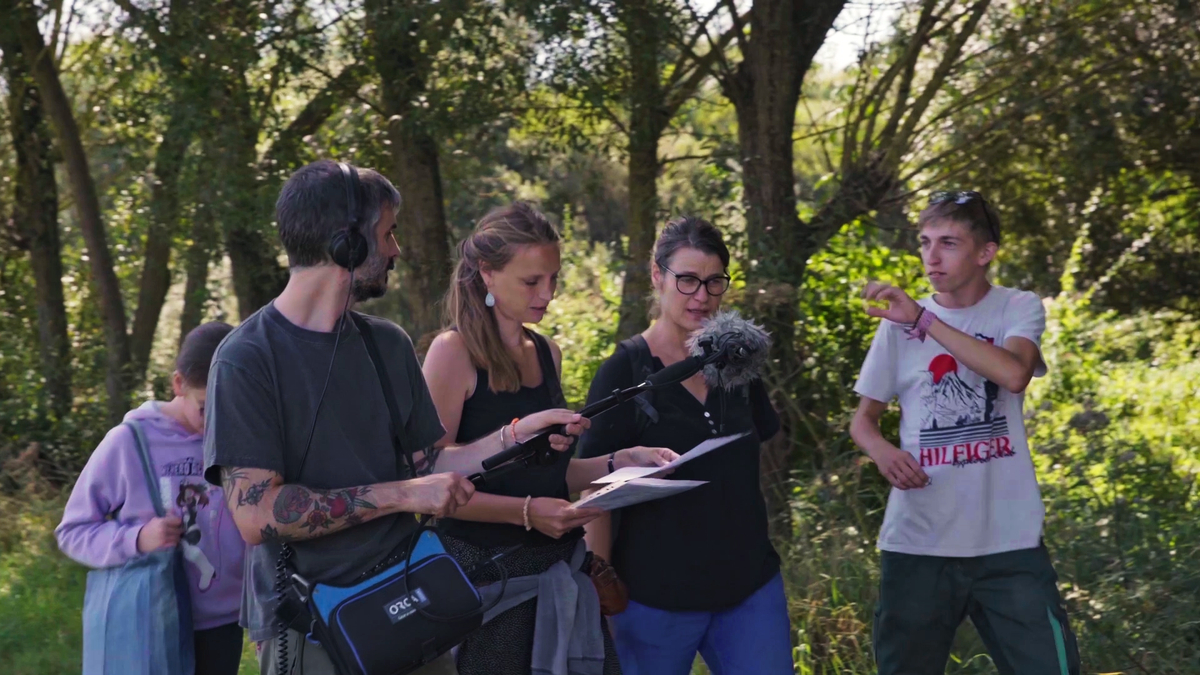
Beyond professional exchanges, Allez! made it possible to establish other links, as shown by the new activities set up in the IES Moisés Broggi and Escola Segarra school centres, the workshops between the participants, the open seminar on Friday and the closing on Saturday. The latter, entitled “Allez! en la Plaza”, hosted on the forecourt of the MACBA a public and fun meeting for the whole family with the programming of several free artistic education activities such as the PUCK, the smallest cinema in the world, the COSA (Organized Walking Sound Center) a mobile sound recording and experimentation station, a staging of multilingual kamishibaïs (paper theater) by the DULALA association, laboratories to print and create a collective fanzine, limitless board games such as an educational photography game Pause Photo Prose and many others.
Towards a collective reflection to act
As the Deputy Delegate of our Foundation for Spain, Isabelle Le Galo, says: ” Come on! has succeeded in creating a new space for dialogue between a wide variety of projects (educational kits, mobile museums and theatres, kits and games, mail art projects, applications and digital platforms, etc.) and the organisations that finance, host or put them into practice, to share their learning in the field of mobility in arts education with generosity, creativity, intelligence and passion “.
In addition, this meeting allowed us to bring together some twenty projects that we supported as part of our call for projects entitled “Educación artística expandida” in Spain and “Innovative tools for mobility in artistic education” in France. Indeed, we are convinced that the creation of spaces for meetings and exchanges between universes is particularly important and we hope that this will lead to new connections and exchanges of practices.
A shared joy
Pablo Martínez, Head of Programmes at MACBA, pointed out that ” one of the main conclusions that can be drawn from our seminar is that there is a very rich landscape of institutional, para-institutional and independent practices that work for the development of learning tools in the arts, (…) as well as in terms of orientations, levels of experimentation and scope, both in terms of territory and audiences. »
Rethinking the current model
The conclusions of the Conference are in line with the request made by several actors: namely that administrations develop the means and tools necessary so that teachers, educators, cultural actors and artistic institutions can do their work in better conditions.
During the seminar, the speakers expressed the need to redefine the place of education in museums, not as a “machine” to attract audiences, but as a research space with a wide variety of audiences, where projects that focus on qualitative aspects and not on essentially quantitative aspects should be promoted.
In this regard, the representatives of the institutions present defended the importance of reflecting on the current model and its transformation, as well as practices that take into account the professional conditions of workers and their needs to ensure the continuity of projects.
In a few days, we will publish the conclusions of the “Go!” Meeting on the mini-website of the seminar and we will disseminate them so that they travel, fertilize and inspire without limits, because we are convinced that there is an increasingly powerful and communicative energy in this way of doing art and society.

«
Mobility is a lever that allows an institution to get out of its comfort zone, to move towards other territories, other audiences, to establish different relationships and to consider itself, not only as a space that must attract more and more visitors, but as a public resource that can serve and reach communities that are different from those initially planned.
»CARLOS ALMELA
Head of the Citizen Art Program Spain of the Daniel and Nina Carasso Foundation


Watch the streaming video of the seminar on March 15: