11 juillet 2023
Feeding the Future 2023 – Food Democracy Special Edition


Our4th edition of our “Feeding the Future” call for projects focuses on democracy and food justice. With the support of the Fondation de France, these 18 laureates join the projects also selected by Nourish the Future, by proposing solutions that break with the one we know to meet the challenges of accessibility and citizen participation in sustainable food.
Promoting accessibility and civic ownership of our food
A major challenge in our Sustainable Food axis, the “Feeding the Future” call for projects has been supporting emerging solutions for the past 4 years that are likely to change the way we produce, process and consume. This year, a significant number of applicants responded to the Foundation by spontaneously proposing operational or research projects on the issue of democracy and food justice. Faced with this significant need, which is also addressed as part of our dedicated programme, we have decided to double the budget devoted to the Feeding the Future call for projects in order to create a special promotion. We also benefited from the support of the Fondation de France. ” The Fondation de France has been active for a very long time on issues of citizen participation, agroecology and the commons to promote the ecological transition,” explains Laëtitia Bertholet, Head of the Ecological and Solidarity Transition Department at the Fondation de France. ” Very close to the Daniel and Nina Carasso Foundation, which is strongly committed to the issues of participation and access to sustainable food for vulnerable people, we naturally made our financial contribution and participated in the selection jury. We are in a philanthropic alliance approach to join forces and have even more impact. »
The 18 winners of this special promotion are all projects in the emergence or consolidation phase focused on accessibility issues, in particular by building effective capacity for physical and economic access to sustainable food. They are also part of a participatory and inclusive approach based on diversity and the diversity of the audiences involved.

«
The jury praised the presence of rural projects, which have so far been less frequent than urban projects. We will therefore be particularly interested in their specific conditions for success. We can also see that the concept of Social Security for Food is spreading, in various forms, with different experiments from one territory to another and various target audiences.
»Mathilde Douillet, Head of Sustainable Food France
“Our project is to make accessible to everyone, and in particular to people who live in precariousness, the possibility of better food, a diet that we want to be healthy, sustainable and joyful.” Joseph Primon, member of the association La Maison Partage.
The winning projects
The Committed and Supportive Food House / VRAC Lyon Métropole
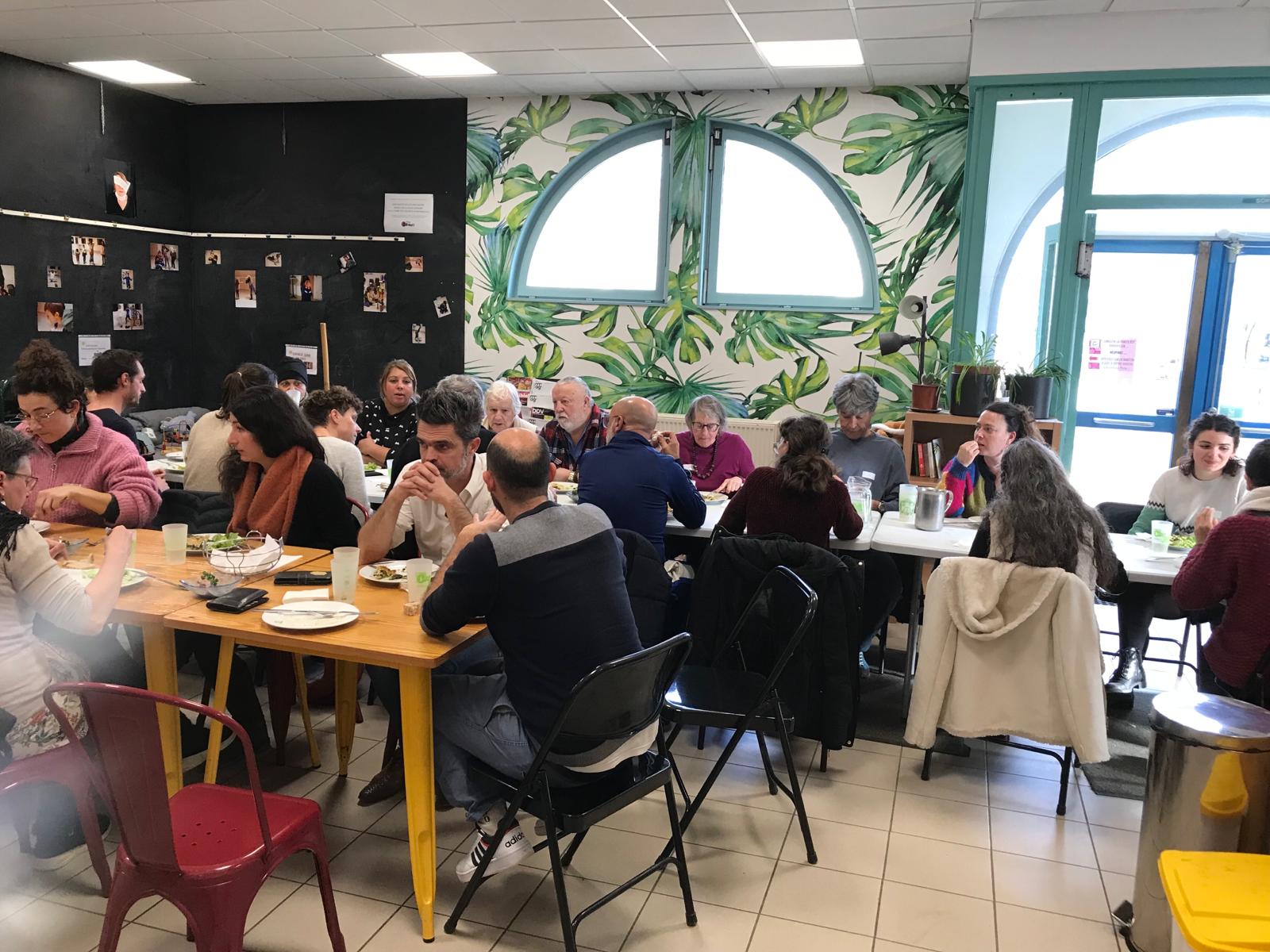
In the 8th arrondissement of Lyon, the Maison Engagée et Solidaire de l’Alimentation (MESA) has been offering since the end of 2022 a restaurant, a cafeteria, a VRAC grocery store, entertainment, “open kitchens” times, with adapted prices to fight against precariousness and leverage food purchasing practices. Collectively cooked solidarity meals are offered every Tuesday, which are a great success.
The actions and objectives of MESA range from seeds to compost and of course the plate.
All guests! Collective itineraries for a right to selected and quality food / AEQUITAZ
The aim of this project is to extend food democracy to people and associations fighting poverty whose core business is not food. By creating and leading collectives of volunteers living in precariousness in several territories including Grenoble, Lyon, and in the Drôme, it is a question of building “food itineraries” with them and responding to 3 injustices: hunger, lack of choice and inequalities in access to food that is good for our health and the planet. The objective is to invent, test and share a popular pedagogy of the food transition, but also to develop advocacy and spin-offs with events, citizens’ assemblies and inter-collective meetings.
Bringing together the actors of agricultural production and food aid / CIVAM Le Serpolet
Extending a partnership around the creation of agri-rural activities in Bourgogne-Franche-Comté, CIVAM Serpolet and ACTIVE SSE Development Pole aim to bring out, lead and support 4 pilot territories around experiments promoting links between actors in agriculture, food aid and social welfare, civil society and territories to facilitate access to quality food at a fair and remunerative price for producers. The dissemination of an impact analysis and a methodological deliverable highlighting the lessons learned from these experiments will serve a local, national and European spin-off.
Villages in Transition – A local food social security fund in Dieulefit and surroundings
In Dieulefit in the Drôme, residents, farmers and shopkeepers have been volunteering since 2021 within a Local Food Council, to make the right to sustainable and chosen food effective. With a view to creating a local food social security fund, they want to increase the number of points of sale, mobilise the population to experiment with the collection of contributions and the payment of an allowance for food purchases, as well as structure their governance.
The Val d’Oise Harvest / Sauvegarde 95
Led by a child protection and prevention association, this initiative emerged in the context of the Territorial Food Project. As part of an integration project, young people from priority neighbourhoods in Cergy-Pontoise organise activities to resell local products without margins at the foot of buildings and raise awareness among residents about good quality food. It is now a question of extending these actions by developing purchasing groups, raising awareness among a wider public and strengthening the economic model.
Construction of the social component of the Bar Radis / Les Ami.e.s Du Bar Radis
The Bar Radis is a third place installed on the roof of a car park in a new eco-district in the heart of working-class districts of Grenoble. The association “Les Ami·e·s du Bar Radis” wishes to develop the social and cultural component of the place by giving a voice to people in a situation of food insecurity to imagine and implement the means of accessible quality food. The mixed discussion circles will reveal the power to act of the people concerned with the creation of programmes and podcasts broadcast via an associative radio station.
Mutuelle de l’Alimentation en Alsace / For an SSA Alsace
Created in 2022, the association “Pour une SSA – Alsace” wishes to create a mutual food company to facilitate and encourage access to healthy food, respectful of people and ecosystems, through a hybrid and solidarity economic model, and a network of points of sale of approved partners. It also aims to set up a shared governance giving citizens the opportunity to guide the development of agricultural sectors.
Intervention research for the evaluation of the impact, process and cost-effectiveness of a cash transfer mechanism coupled with social guidance for households in precarious situations / Action Against Hunger (ACF)
Carried out in partnership between Action Against Hunger and INRAE (MOISA), this project proposes to co-produce knowledge on the implementation of an unrestricted cash transfer and social guidance mechanism for people in precarious situations and on its effects on food security, well-being and the sustainability of household diets. Following on from a “Gateway” pilot phase carried out in 2022, the project will assist a minimum of 452 households over a minimum of 4 months at an amount of €60 per person per month. The results of the evaluation will provide food for thought on alternative approaches to food aid in France.
Les P’tits MaMaPots / MaMaMa
Born in Saint-Denis during the lockdown, the MaMaMa association fights against child food insecurity in Ile-de-France in partnership with PMIs, health centres, social workers and associations. After the distribution of solidarity parcels, she wants to experiment with a production-processing-distribution system for small organic jars in integration projects with local supply from farmers. This project aims to strengthen the physical and economic access of women and children in very precarious situations to quality food. The survey conducted in 2022 with ACF did indeed point out the shortcomings of conventional food aid in meeting the specific nutritional needs of child populations.
Democratic Strata / AAU-CRENAU Laboratory
This action-research project addresses the issues of territorial commons and the new social contract on food in the metropolis and in rural areas. Participatory and strategic, this initiative brings together 3 collectives carrying out experiments in the co-construction of territorial policies: elected officials and citizens committed to the Communal Agricultural Policy of Plessé (agroecological transformation, reception, installation, transmission, citizen preservation of soils, short circuits), bearers of the agricultural installation and transmission policy carried out in Nantes Métropole and the Nantes-Redon Reciprocity Contract, and the collective carrying out the experimentation of the Caisse Commune Alimentaire de Nantes. Reflection seminars, visits and the publication of a book on promotion will mark the progress of this research.
Promoting and speaking out for people affected by food insecurity together / VRAC Paris
Since 2021, VRAC Paris has been supporting a collective of residents of the Charles Hermite district who are meeting to regain the power to act on their access to sustainable food. The purpose of the project is to build a food democracy in Paris, by strengthening the capacities of citizens’ collectives in the 18th and 19th arrondissements, concerned by food insecurity, to build advocacy and bring it to political and institutional authorities. Mobilizing a popular education method developed by Aequitaz, the actions concern the support of the collective to better understand the food system; imagine possible actions inspired by existing initiatives; build advocacy and bring it to a day of restitution.
Les Paniers du Quartier: research-action for more solidarity and democracy in our food / Maison de Quartier St Nicolas
In Romans-sur-Isère, a collective of 3 social centres proposes to strengthen access to quality food for the inhabitants by drawing inspiration from the Social Security for Food approach. Based on their experience of a mobile and solidarity cannery and neighborhood baskets, the project will provide a better understanding of the obstacles and levers of access to food through a research-action approach; structure 3 citizens’ collectives around solidarity purchasing groups and an assembly to reflect on the implementation of a common food fund; raise awareness among residents through workshops.
From an experiment of hanging baskets to a concerted social food system in rural areas / Bio Ariège-Garonne BAG
Led by the Bio Ariège-Garonne association, this project aims to improve access for all to healthy, fair and more broadly sustainable food in the rural territory of Saint-Girons. Its objectives are to develop a micro-experiment in solidarity baskets financed by the customers of a Biocoop and private actors, and to develop it according to the principles of food democracy and Social Security for Food (SSA). This experience will be shared in regional and national networks active on SSA, agricultural transition and food democracy
Growing, cooking and creating together / The Shared House
Created by the ATD Fourth World committee, the Shared House is located in the former social center of Les Gauchetières, a political district of the City of Val in the rural commune of Nogent-le-Rotrou. Bringing together people facing extreme precariousness, wealthier citizens, producers and local actors in solidarity, the project provides for the development and equipment of a food garden, the establishment of a shared kitchen and kneading machine, convivial social and cultural activities (workshops, events, training/information, etc.), health (awareness, care) and in the longer term a place of social housing. He also envisages the development of the solidarity market and the constitution of a solidarity fund dedicated to food accessibility for the most disadvantaged.
The Negreneys Footbridge / Sozinho Association
Located in the north of Toulouse, the Passerelle Negreneys is a social life space that acts daily with the inhabitants of this Political Quarter of the City through cultural and artistic events. The project aims to create a participatory catering service as well as educational and hospitality workshops for culinary project leaders. The Foundation’s support is intended in particular for the creation of the incubator and the financing of training courses on sustainable food and in particular waste.
Articulating the challenges of agricultural production and the change in consumption patterns / La Butinerie
Bringing together public, private and citizen actors in Pantin, La Butinerie is a nourishing third place, a place of life, nutritional education, social justice to work on the issue of food sovereignty, to support and experiment with solutions, based on the social realities of vulnerable inhabitants. This house of food well-being includes a Biocoop store, a canteen, a café, a kitchen and a garden which are support for activities. This multi-year project develops several actions around convivial times, exchanges and information, nutritional workshops, distribution of products during the Water Market.
Co-construction of the shared governance of Soli’doume / ADML63
Soli’doume seeks to make healthy, sustainable and quality food accessible to as many people as possible, both through financial redistribution, support for changes in eating behaviour, and the mobilisation of all stakeholders in the local food system around this objective. Led by ADML63 (Association for the Development of Local Currencies in the Puy-de-Dôme), this project aims to consolidate the experimental SSA system launched in 2022 by working in particular on the co-construction of a governance tool allowing the opening of the Soli’doum project to a greater number of actors (from production, processing, distribution, but also associations, communities and consumers) who want to participate in the transition to a sustainable food system for all.
Experimentation of a Social Security for Food for Students / CREPAQ
The project to experiment with an SSA for students on the Bordeaux campuses is led by two associations: CREPAQ (regional association for action for an ecological and solidarity transition in Nouvelle-Aquitaine) and LA GEMME (association managing the local currency of Gironde). CREPAQ has a strong involvement in the fight against the84 | Sustainable Food France 2019 – 2023 | Daniel and Nina Carasso Foundation Feeding the Future and Explorations | Feeding the Future Special Edition Food Democracy – 2023 | 85 food waste and food insecurity, but places this involvement in the context of food resilience and democracy, which must profoundly transform the food system and give back to citizens the power to act. The SSA project for students consists of giving them financial leeway so that they can access sufficient, healthy, quality, local and sustainable food in approved shops and producers. This project is co-constructed with student associations, the universities and schools concerned, local authorities and associations
local food systems, and plans to involve researchers in its evaluation system.
Suspended markets / Movement for the Solidarity Economy in Occitanie
The Movement for the Solidarity Economy Occitanie is a network of organisations, companies and citizens that advocates
on 3 pillars:
1. Citizenship and economic democracy from the perspective of social justice, human and cultural rights
2. The transformation of socio-economic models and a systemic ecological, economic, democratic, social and societal transition
3. Local territorial development in an approach of emancipation and popular education.
In a context where food aid serves as an outlet for agribusiness surpluses by considering precarious citizens as beneficiaries at the end of the chain, the Suspended Markets in phase 2 (logistics and animation) offer a niche local supply chain – based on 10 open-air or covered farmers’ markets in Toulouse, associating precarious people, producers and consumers.