12 juillet 2024
Study day Food democracy in rural territories: restitution 30 May 2024


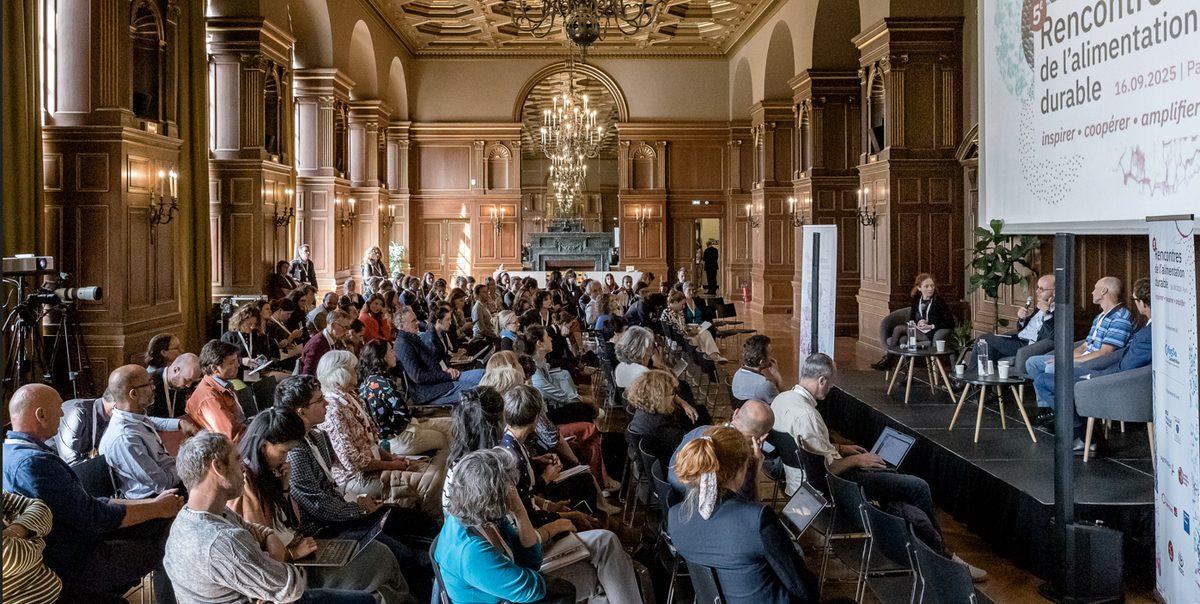
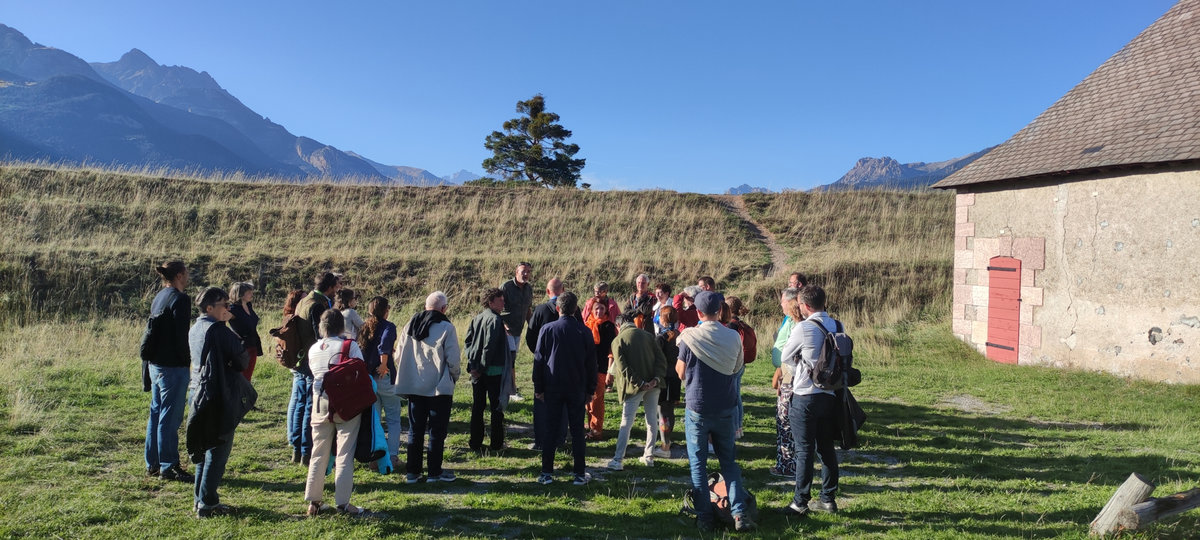
On 30 May 2024, the study day “Food democracy in rural areas, challenges and prospects for local authorities” was held in Angers. Thank you again to those who participated and contributed to sketching as closely as possible the reality of food democracy on the ground in our territories. A look back at a day rich in lessons learned and sharing of experiences.
The morning of this study day was first devoted to thematic insights by four partner structures of the Daniel and Nina Carasso Foundation.
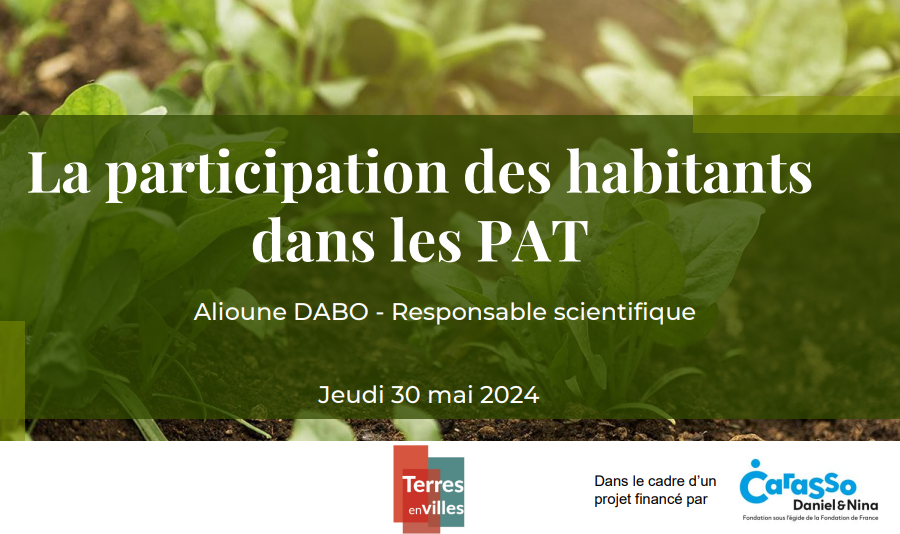
The first part was devoted to ” theparticipation of the inhabitants in the Territorial Food Programs (PAT) “. Alioune Dabo, Scientific Manager at Terres en Villes, presented the results of a study he conducted on the subject, the objective of which was twofold: to characterize the modalities of involvement of residents in the PATs; and to show how local authorities allow them to increase their skills on the subject of food democracy, through a variety of mechanisms. Some lessons to be learned from this study:
– the more mature a PAT is, the more it implements mechanisms for popular participation;
– in rural areas, young people are the most difficult to mobilize; In urban areas, on the other hand, it is people in precarious situations that are more complicated to involve.
– there is a “gradient of involvement” of populations in the PATs (from public awareness to the capacity building of the inhabitants). This gradient depends mainly on the themes mobilised in these PATs, but also on the willingness of the project leaders to directly integrate citizen participation.
” Creating participatory workshops, animation positions, setting up local youth committees or neighborhood councils are all avenues to be studied to improve the participation of residents in the PATs ” (Alioune Dabo).
Oriane Marcadet, Food Project Manager in the Pays des Châteaux, and Nicolas Orgelet, Vice-President of the Blois agglomeration in charge of the ecological and energy transition, then gave their testimonies from actors in the field.
” The study carried out with Terres en Villes was very interesting for us, in order to understand what works better elsewhere. This allowed us to identify, for example, that we lacked citizen support, that we should allow people to feel that they were actors in the process, in particular through a co-decision process ” (Nicolas Orgelet).
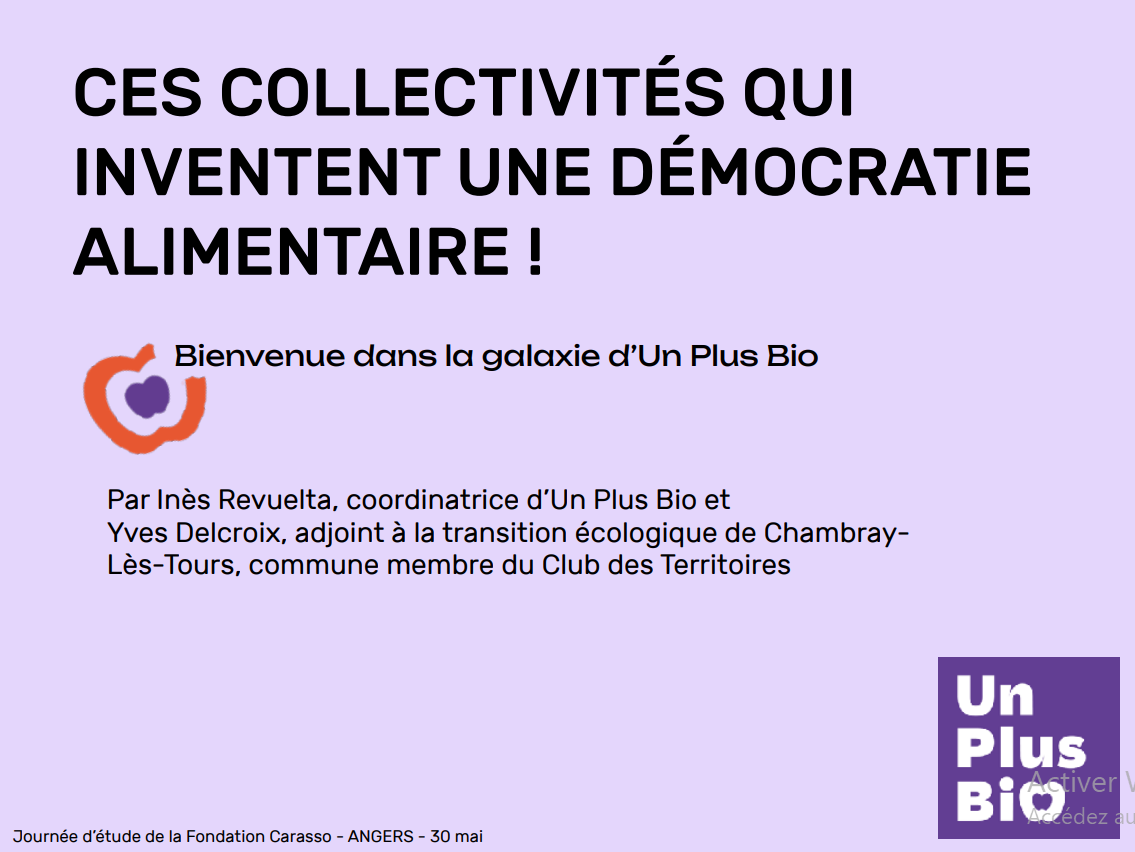
For her part, Inès Revuelta, Facilitator-coordinator at Un plus bio, then presented the work of her structure to ” help local authorities invent food democracy “.
Previously very marginal, the subject of food democracy is emerging in the territorial policies of local authorities, in particular via school canteens: it is because elected officials have the responsibility to provide healthy, local and low-cost food to their population that a proactive policy on the subject arises.
To help local authorities – especially the smallest ones that do not have the means to have jobs dedicated to food – Un plus bio lists existing initiatives, collects reliable data as elements of arbitration, through various means (Observatory of Organic and Sustainable Collective Catering; specific book “Feeding, when food democracy goes to the table“, etc.).
The association particularly insists on four pillars to change the way we look at food democracy:
– Imagine the canteens of tomorrow, in order to provide canteens with real and measurable objectives, to put in place transparency mechanisms and to improve training and working conditions for people;
– Create a public health policy that focuses on organic products;
– Restore a nourishing vocation to land, with the aim of favouring the establishment of local agriculture, while securing outlets for producers;
– To give life to food governance, by allocating resources dedicated to a food policy, and by creating nurturing spaces for producers and eaters to meet.
” We can’t consider food as an ordinary good: there is a food exception. It is a strategic lever for changing perspectives ” (Inès Revuelta).
Yves Delcroix, Municipal Councillor in charge of the ecological transition in Chambray-Les-Tours, then illustrated the involvement of his peri-urban municipality in a food democracy approach through the detailed example of the establishment of the municipal vegetable farm.
” The support of Un plus bio was very important in setting up this farm. Sharing experience with more advanced municipalities was very useful to us and made us want to dive into the project ” (Yves Delcroix).
Brigitte Picandet, Programme Manager at Resolis, and Lucile Dumoulin, former Project Manager at the National Federation of Regional Natural Parks (PNR), presented the Resolis Observatory, which aims to be a ” support for the promotion of inspiring food democracy initiatives “.
Brigitte Picandet first recalled that Resolis has set up an Observatory for about ten years, which currently lists more than 2000 citizen initiative sheets in the field of responsible and sustainable food in the territories. Based on interviews with local actors or project leaders, these summary sheets are built on the same methodological grid, which allows a comparison between their different territories of establishment. For Resolis, the objective of this observatory is twofold: to improve knowledge of local ecosystems on responsible and sustainable food and to enrich a database of initiatives, which is accessible to all. The Observatory thus makes it possible to equip cartographic or thematic research on a variety of initiatives in France and abroad. In addition to the fact sheets, the association also provides many resources on the subject of food democracy.
In this context, Lucile Dumoulin then briefly retraced the involvement of the national federation of NRPs alongside Resolis in this work of observation, accompaniment and support of innovative and local initiatives in favour of more sustainable agriculture within the NRP network. Initiated in 2018, this collaboration aims to create a network of references and exchanges between a dozen pilot parks on responsible and sustainable food initiatives and on the dynamics of building PAT, focusing more particularly on the importance of processing logistics tools (slaughterhouses, vegetable factories, etc.).
” This Observatory is a valuable tool for spreading local initiatives while highlighting their particularities through interviews with actors in the field.” (Lucile Dumoulin)
To end this morning, Louise Galipaud, Coordinator of the TETRAA programme, presented feedback on observations on ” the levers of local authorities to implement food democracy “.
The TETRAA programme supports nine territories (including eight local authorities), selected through a call for applications, via a triple support, financial, operational and scientific. A website dedicated to the programme details these elements and offers a range of resources. In order to remove the many obstacles identified on the subject of food democracy (disconnection between the long time of a community and the time of civil society, lack of a culture of dialogue between public and private, technicality of the subject and impression of limited room for manoeuvre…), Louise Galipaud insisted on the importance of two main elements:
– a necessary animation of participatory and decision-making bodies, with the creation of dialogue, steering and decision-making bodies, in which the role of each and every one is clarified from the start;
– a necessary political support on these issues of food governance, through the training of elected officials.
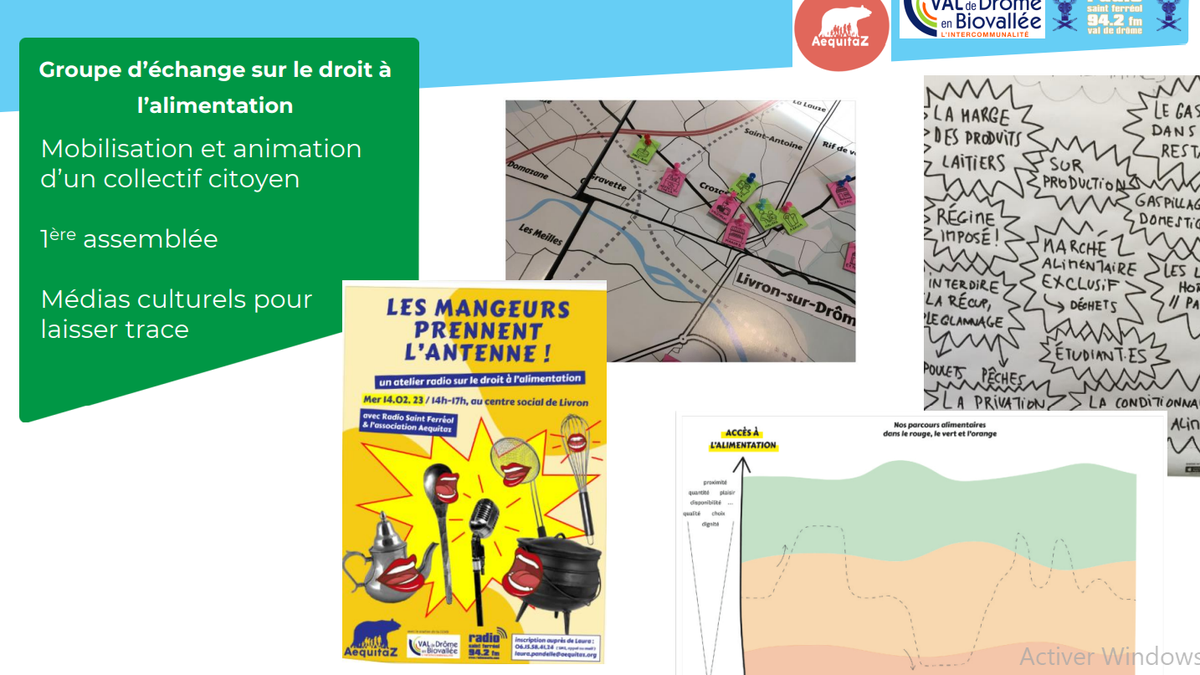
Anaïs Sinoir, Food project manager at the Community of Municipalities of the Val de Drôme, testified to a lever supported by her community in her territory. This involves the establishment of a citizen exchange group on food democracy, in particular through the realization of radio capitalization workshops.
” Even if the sample of participating citizens is not representative, this approach is very interesting for us because it allows us to really include citizens in food governance, through public support, training, project proposals and dialogue with elected officials ” (Anaïs Sinoir).
In order to extend and deepen the exchanges and feedback, the afternoon continued with discussions on the difficulties and obstacles of local authorities in appropriating this notion of food democracy, but also avenues for reflection and levers of action allowing them to overcome them. Thus, several questions were debated during a dedicated round table: How to create a system and integrate all the actors of the food system? At what scale should public food policies be implemented? How should we think about the interweaving of scales? What place do residents play in governance? What cooperation between rural and urban territories?
Representatives of Un Plus Bio (Stéphane Veyrat, Director), Terres en villes (Alioune Dabo, Scientific Manager), Resolis and the Federation of Regional Natural Parks (Lucile Dumoulin, former Project Manager) were crossed. Patrice N’Diaye (Lecturer-researcher in Public Law at the University of Montpellier) came to provide a conclusive summary. A few major points emerged from their discussions.
1) Firstly, the reflections and actions carried out around public policies in the field of food democracy still do not go far beyond the sole prism of agriculture, in the logic of structuring sectors (collective catering in particular). In this respect, the influence of political orientations at the national level (Ministry, National Food Programme) and European level (Common Agricultural Policy) is recalled and contributes to strengthening this productive prism. The appropriation and common use of resources (water and land for nourishment, increasingly competing with energy needs, for example) are points raised in connection with this agricultural field. That of the diversification of agricultural models as well. In the eyes of the speakers, it appears that certain types of farmers, more alternative, work more with local authorities on this issue of food democracy, in a different way of thinking from those in the conventional agricultural world. And this dichotomy of models tends to become more pronounced, whereas many local authorities seek to make them co-exist together on their territory.
The involvement of the intermediate links in the systems also arises, particularly around logistical tools (transport, processing) that could facilitate the relocation of supplies. Some changes in this agricultural entry, with the involvement of more and more local authorities in the issue of food insecurity (in connection with territorial food projects).
2) Secondly, local authorities seem to be facing two questions to become more involved in these issues of food democracy. There is a real need to increase their skills on this subject so that agents and elected officials can get more involved, exchange with their fellow citizens, and thus gain legitimacy. While relying on the existing resources of one’s territory is recalled by the speakers in the preamble, the needs in animation engineering as well as in resources (human, financial) were particularly highlighted. The involvement of a diversity of partners, a greater autonomy of the actions of others, or the interest of having a governance body are all elements discussed in an attempt to provide solutions to these important needs, particularly within “small” communities. That of being able to benefit from studies and observations on sustainable food, on a regional scale and over a long period of time, too. However, we must be careful not to multiply these already abundant tools, but undoubtedly by sharing and pooling them.
3) Thirdly, thelevels of scale of cooperation are a point particularly discussed by the speakers. The question of the institutional scope of this cooperation appears necessary, particularly in view of the increase in the skills of metropolises and regions on agricultural and food issues. As such, local actors such as inter-municipalities, project territories (such as countries or regional natural parks), and even departments appear to be relevant levels, capable of going beyond juxtaposition and triggering a change of scale in initiatives and actions around food democracy.
Beyond that, the necessary cooperation between urban and rural territories seems obvious. This must obviously be thought out in a flexible spirit of reciprocity, multi-partner inclusion and shared governance, especially since many communities no longer have enough nourishing land. This cooperation is also a guarantee of greater operationality, particularly when it is developed within the framework of a PAT.
4) Engage in a transition or transformation of agricultural and food systems for local authorities? The question was not decided during this round table, but understanding this issue through the prism of food democracy calls for “changing the focus a little” according to our four speakers.
Addressing these agricultural and food issues through the notion of landscapes and environment would perhaps make it possible to take better account of the lived experiences and representations constructed by the various actors in the field. This approach also invites people to (re)discover the diversity of agricultural and food professions (craftsmen, food trades, etc.) in a country where gastronomy is an important cultural foundation. Awareness-raising and popular education activities on food, in a festive and friendly dimension, would be interesting to deploy more in order to reach a diversity of inhabitants and citizens.
Stimulating the ability of stakeholders to dialogue and build together the food future of their territory therefore appears to be a project that local authorities should continue to explore, in a participatory approach of co-construction of governance bodies and dedicated mechanisms. In this respect, the proliferation of food democracy initiatives over the past ten years, often accompanied by local authorities, is undoubtedly one of the signs of the reappropriation of these food issues. Several avenues for in-depth measures have been outlined, such as the creation of municipal agricultural/land management companies, the promotion of a food exception on a legal level, the establishment of food third places, or the creation of a food commons with social security experiments on food supported, or even experimented with, local authorities… They will have to be consolidated and duplicated so that a genuine right to food can be realized…
The speakers of the day
Session 1 “The participation of inhabitants in Territorial Food Programmes (PAT)”
- Alioune Dabo, scientific manager at Terres en Ville
- Oriane Marcadet, food project manager at the Pays des Châteaux
- Nicolas Orgelet, vice-president of the Blois agglomeration in charge of the ecological and energy transition
12 juil. 2024 · PDF 929 KB
Session 2 “These communities that invent food democracy”
- Inès Revuelta, facilitator-coordinator at Un plus bio
12 juil. 2024 · PDF 835 KB
- Yves Delcroix, municipal councillor in charge of the ecological transition in Chambray-Les-Tours
12 juil. 2024 · PDF 129 MB
Session 3 “The levers of local authorities to implement food democracy”
- Brigitte Picandet, Program Manager at Resolis
- Lucile Dumoulin
12 juil. 2024 · PDF 5 MB
Session 4 “The levers of local authorities to implement food democracy”
- Louise Galipaud, TETRAA Programme Coordinator
12 juil. 2024 · PDF 2 MB
- Anaïs Sinoir, food project manager at the Community of Municipalities of the Val de Drôme
12 juil. 2024 · PDF 479 KB