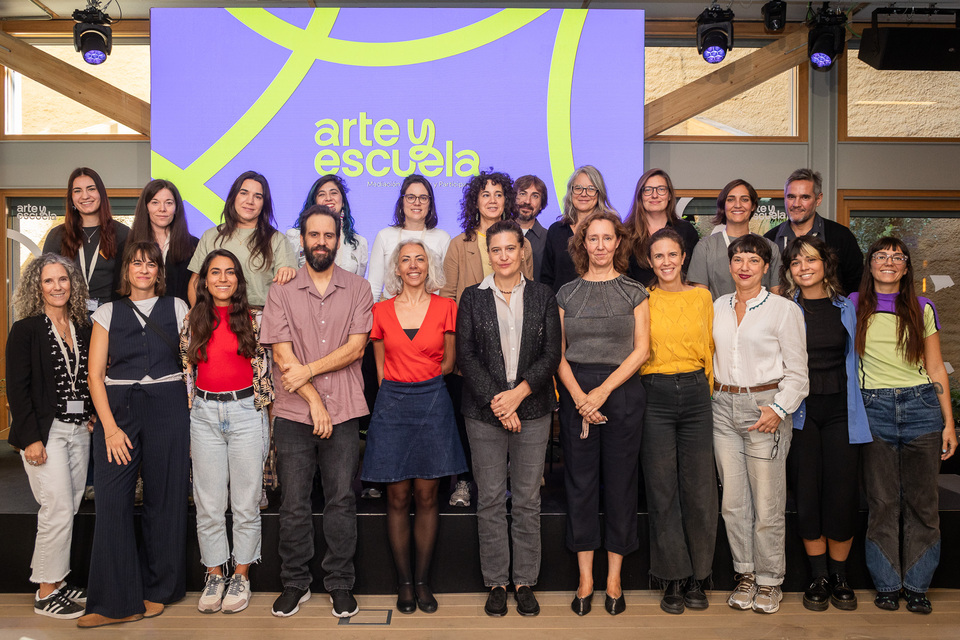
Socially engaged art
01 December, 2025
Anchoring artistic and cultural education as the backbone of citizenship


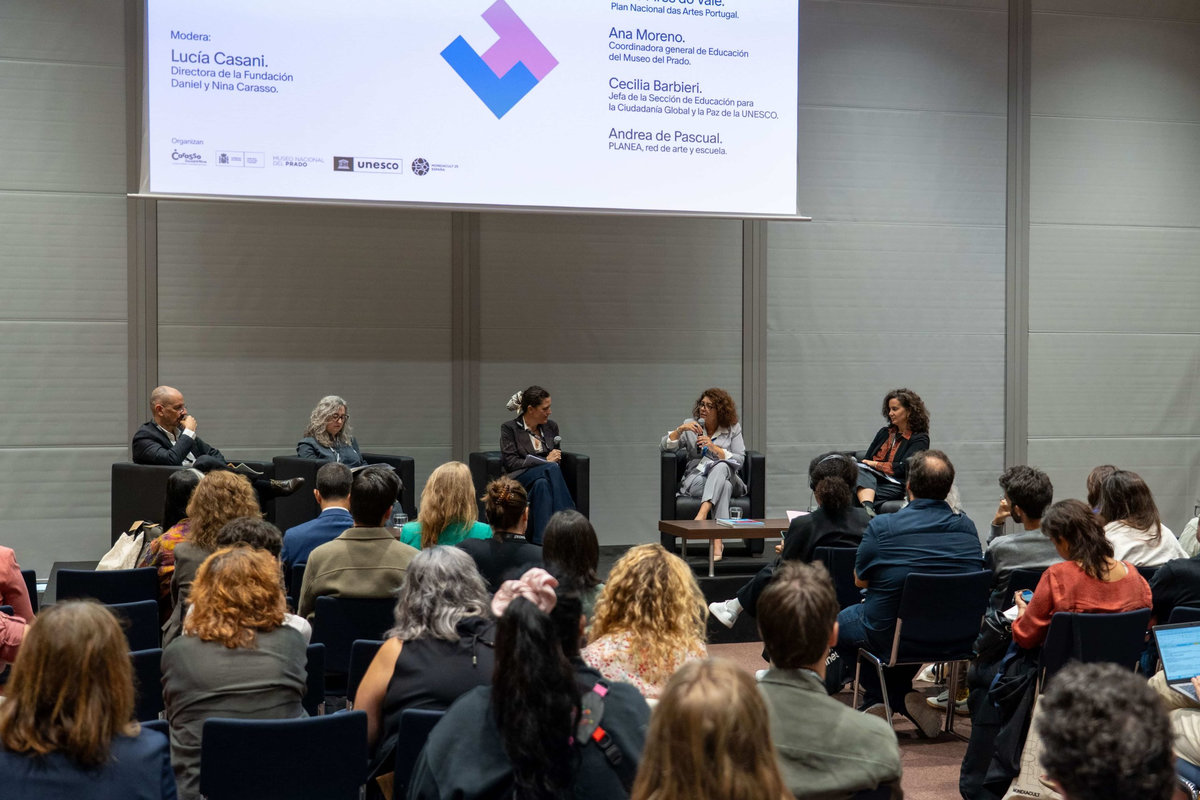
At a time of deep social fractures and urgent planetary challenges, at the Daniel and Nina Carasso Foundation we promote art as an inalienable force to weave fairer and more sustainable futures. With this vision in mind, we organised a round table on 1 October under the title When art enters school, the possibility of another future is born – together with the Museo Nacional del Prado – within the framework of the World Conference on Cultural Policies (Mondiacult). This UNESCO forum turned Barcelona into an epicentre of reflection and action around culture, where the role of educational institutions was revealed as transcendental for social change.
The table brought together very diverse voices, with the aim of generating a space in which both political decision-makers and agents of the sector could dialogue, share experiences and reach consensus. Thus, in the dialogue, moderated by Lucía Casani, Director General of the Daniel and Nina Carasso Foundation for Spain, Cecilia Barbieri, Head of the Section of Education for Global Citizenship and Peace at UNESCO; Paulo Pires do Vale, curator of the National Arts Plan Portugal; Ana Moreno, general coordinator of Education at the Prado Museum and Andrea de Pascual, member of PLANEA, an art and school network. They also participated in row zero as guests Nela Riehl, president of the Committee on Culture and Education of the European Parliament; Jazmín Beirak, Director General of Cultural Rights of the Ministry of Culture of Spain; and Gemma Carbó, representative of the Alliance of Foundations for Artistic and Cultural Education.
The conversation laid the foundations for an inspiring roadmap to dismantle barriers, reimagine spaces and consolidate artistic and cultural education as the backbone of citizenship. The shared objective is to move towards a consolidation of art in schools as a stable, transversal State policy with a real capacity to transform our societies.
One of the challenges that were identified is the need to overcome electoral cycles and political short-termism. In this sense, Cecilia Barbieri focused on the urgency of having stable cultural and educational policies. “Art education cannot be a one-day flower, dependent on a single term of government. It needs an institutional anchor that makes it a state policy,” he said. For UNESCO, the key lies in forging a shared narrative that elevates culture and education to the level of a national pact, and not just a government agenda.
This stability requires a multi-layered work strategy, from the commitment of institutions to the involvement of local reference spaces, always with a vision that ensures the participation of all civil society actors. Only in this way can arts education be given the priority it deserves, guaranteed by strong regulatory frameworks.

Culture and education must be intrinsically linked to peace, human rights and sustainability. Art, from this point of view, not only generates beauty, but also develops the essential civic skills to face the dilemmas of the future
Cecilia Barbieri
Chief of UNESCO's Section for Global Citizenship and Peace Education
For his part, Pablo Pires do Vale, stressed that stability is possible when it is designed with a long-term vision, as is the case of the National Arts Plan in Portugal, which is a beacon of inspiration. “Our plans are projected over 10 years and this allows the change to be structural and not just cosmetic,” he explained. In addition, according to Pires do Vale, the school plays a fundamental role but it is not the only space: art must colonize from cultural institutions, to city councils and the private sector. “A transversal strategy is required, because real transformation in the school depends on its environment moving with it,” understanding culture as an engine of territorial development.
The speakers agreed that leaving school to participate in cultural life should be a daily occurrence, just as entering schools should be a daily occurrence for cultural institutions. In the same vein, Ana Moreno said that the Museo Nacional del Prado is increasingly working on educational programmes with a focus not on “visiting the museum”, but on “inhabiting it”. The aim is to turn the institution into an educational territory in itself, bringing museum practices – such as dialogue, experimentation, slow and disruptive thinking – to the educational system. “Continuity is fundamental: training must go through all educational stages and the museum must be at the service of society and offering art at school as an experience accessible to all people,” Moreno emphasized.
Art offers a space for vital experimentation, not only for children and young people, but also for teachers, who require tools and updating. “Art and culture are not just another subject, but a transversal space,” said Andrea de Pascual, as part of the PLANEA network, an example of the alliance model that we promote from the Daniel and Nina Carasso Foundation. The challenge is to avoid the rigidity of the educational system and to ensure that “art does not remain on the margins”, but rather serves to update methodologies, enable pedagogical innovation and bring the tensions of the present to the school, thus improving the capacity for action and academic results”.
In this same sense, when giving way to the participants of row zero, Lucía Casani stressed the importance of public-private partnerships “so that art becomes a tool for fundamental transformation in schools, for the integral development of students and to generate possible futures”.


From the field of public policies, Jazmín Beirak Ulanosky showed her willingness to turn cultural education into an unavoidable structural axis. In Spain, this institutional support for the binomial art and school is materialized by the Ministry of Culture itself, which “has made transfers to the Autonomous Communities to finance artistic projects that can be permanently integrated into the very functioning of educational centers.” As the promoter of the Cultural Rights Plan, Beirak stressed the importance of mediation and specific training for teachers that can provide them with tools for this new pedagogy. This is already being carried out with initiatives such as the open training activity “Art and school: Educating for cultural participation” coordinated by Gemma Carbó.
For her part, Nela Riehl stated that it is necessary to “transform school disciplines” in order to, in a certain sense – as Pires do Vale proposed – “indiscipline the school”, understanding art beyond the learning of a subject or a technique. In addition, he delved into the role that, at the institutional level, the European Union can play and expressed the need for “the European Parliament to support the Member States to have stable processes”. The challenge is to avoid vertical policies and move from the “democratization of culture” to “cultural democracy”, since while the former brings culture to the people, the latter builds it with them.
In a space like Mondiacult, where political decision-makers and civil society meet to dialogue and build together, this dialogue promoted by the Daniel and Nina Carasso Foundation not only served to share good practices but also activated a commitment to a future where culture, through education, can constitute the foundation of social cohesion.
The debate in Barcelona also served to reaffirm the conviction that the importance of art in schools is now unquestionable and that artistic and cultural education is not a mere curricular complement, but an essential infrastructure for forming critical, empathetic human beings capable of imagining creative solutions to the problems that challenge us.