Socially engaged art
23 February, 2026
NOTE IV presents the results of the residencies


At the Daniel and Nina Carasso Foundation, we understand cultural mediation as a place where art connects with life and where knowledge is built in a shared way. It is not only a matter of facilitating access to culture, but of generating conditions for active participation, critical thinking and the creation of sustainable links between institutions, agents and communities.
Supporting mediation is, for the Foundation, a commitment to practices that expand cultural rights, promote the diversity of voices and contribute to a transformative culture. To this end, together with the hablarenarte association, we promote the NOTAR initiative, which develops research residencies in cultural mediation that allow professionals to promote and consolidate their professional practice on critical pedagogies and experimental mediation, as well as the collective articulation of a forum or community where they can resonate, converge and amplify each other.

At the Foundation we are aware that promoting research processes in the field of mediation is important to increase knowledge and democratize access to it
Cristina Sáez
Citizen Art Program Manager
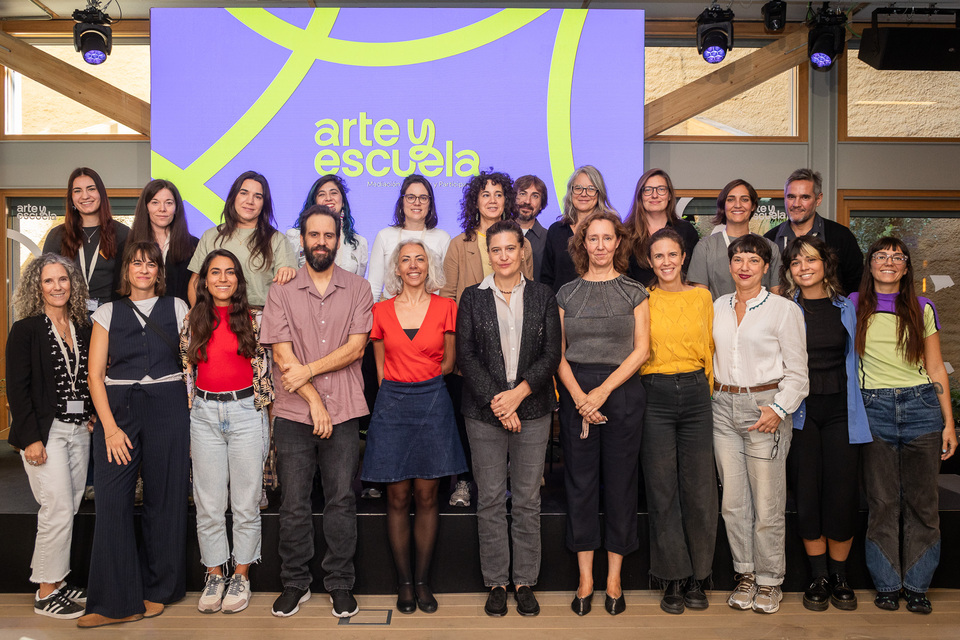
The fourth edition of NOTAR took place between September and November 2025 and on February 11, at the event Exhala, mediation practices in active rest , the results of the three residencies were presented, along with another project from the previous edition. The Daniel and Nina Auditorium of Infinito Delicias hosted this opening of the research processes to the public. More than a sample of results, it was an invitation to stop: to exhale after the vertigo of production and to think about what happens when the practice enters active rest.
Two months after concluding the residencies, the day was proposed as a space to share processes and drifts that have not yet been closed. Instead of presenting results, tools, questions and devices were shared that allow other agents to replicate, adapt or stress what they have learned. During the afternoon, an itinerary of activities was followed that showed different formats: a playful device, a performative questionnaire, a body tour of architecture and a performative conference crossed by migrant memory.

What we mean by research is a big question that runs through nursing homes. We are very committed to those spaces that are on the edges, in coexistence, where the unexpected happens. For this reason, we insist on the importance of corporeality
Flavia Introzzi
to speak to you. Coordinator of the NOTAR program and head of the artistic residency program Planta Alta
In all cases, mediation appeared as an expanded practice. It was not a matter of explaining methodologies from a distance, but of activating them with the audience: playing, debating, moving, listening, remembering. The collective experience showed that research in mediation involves reviewing one’s own doing, questioning naturalized hierarchies and translating learning into tools that can be shared.
Exhala confirmed that rest is not inactivity, but a fertile time during which the experience of research is transformed into resources, such as Massa Salvatge’s game, Jordi Ferreiro’s journey, Parkuir’s publication or the living archive of Diana Castro and Marianela Vega Oroza. NOTE thus continues to bet on mediation as a space for critical thinking, situated creation and network building.
*Images of the presentation made by Lukasz Michalak, from Estudio perplexo.
Massa Salvatge — Worldviews: Nodes of Care for an Anti-Adultist Mediation
Teresa Mata and Alba Oller, from the Massa Salvatge collective, presented a game, a playful device, arising from their research in NOTE III. Conceived as a tool for debate, the project brings together reflections drawn from her practices and from other colleagues in cultural mediation with children. The audience, divided into smaller groups, was able to enjoy the game, with which, through three categories (contexts and powers, educational act and register), questioned the centrality of the adult gaze and proposed to attend to the needs, desires and forms of agency of children.

Jordi Ferreiro — Duck or rabbit?
Starting from the well-known ambiguous figure that can be read in two ways, Ferreiro opened a fundamental question: can cultural mediation be considered an artistic practice? The session took the form of a performative questionnaire that promoted reflection by the audience present, including mediators and artists, on their own practices and how they see themselves. Her practice, which blurs boundaries between art and education, uses play and estrangement to question how museums and art centers manage knowledge.

Parkuir — Performative Visit to Infinito Delicias
Guiu Gimeno and Maria Laudes showed their experiences during the research and presented a publication that offers a compendium of replicable resources to reformulate our way of looking at and inhabiting the world from a queer, anti-morphophobic and non-ableist perspective. During the last part, the duo invited the audience to take a tour of Infinito Delicias testing the architectural structures through drag.

Diana Castro & Marianela Vega Oroza — Open the file
In collaboration with the Casa de la Cultura Andina, the proposal was based on the question: where and how are the stories of migrant bodies, especially those of Latin American women in Spain, archived? Through a performative conference that articulated audiovisual, testimony and objects loaded with affective memory, they proposed the creation of a living and mutant archive. The piece explored the experience of migrating and turned mediation into a gesture of collective care and construction of shared memory.