Socially engaged art
15 October, 2026
The Arte y Escuela Conference addresses how to give continuity to arts education


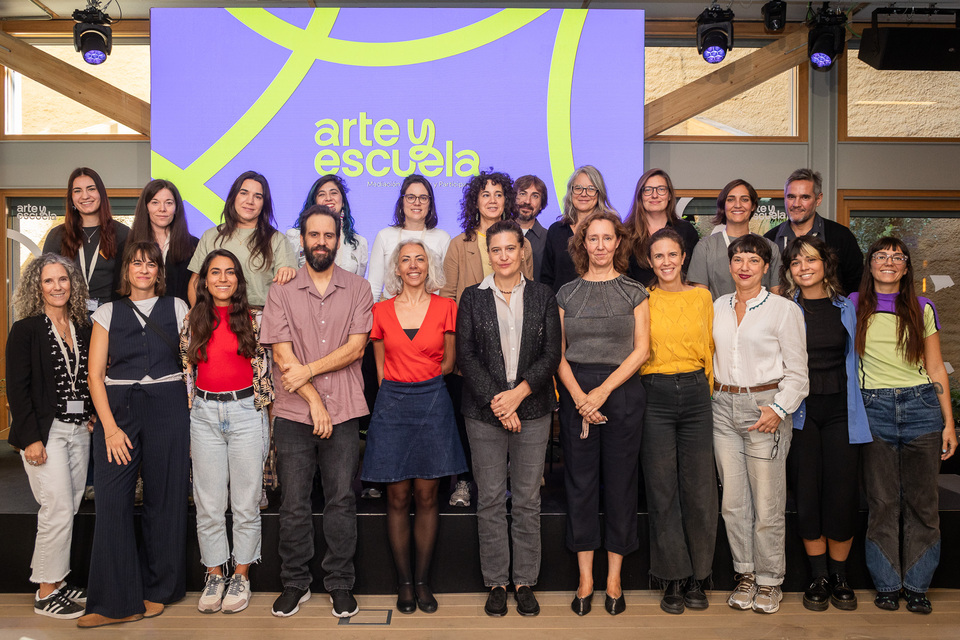
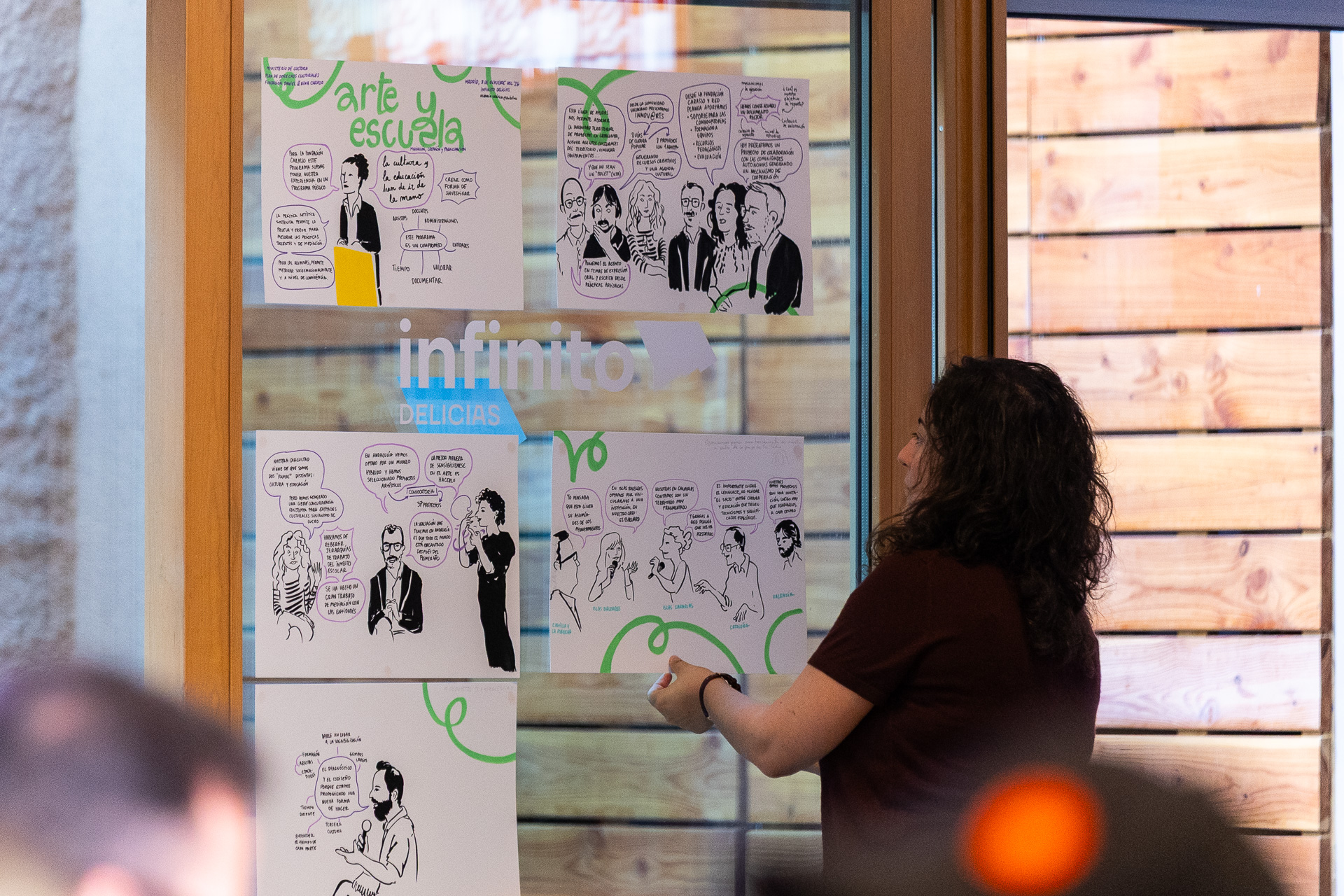
Classrooms are already making films, dancing, creating podcasts and telling stories through art. The challenge is to ensure these experiences have continuity. How to achieve this, and what obstacles must be overcome to do so, was one of the central themes of the Arte y Escuela Conference: Mediation, Creation and Participation, held on 8 October at Infinito Delicias (Madrid).
Organized by the Ministry of Culture and the Fondation Daniel et Nina Carasso, the gathering brought together public administrations, artists, teachers and mediation professionals to share experiences that bring film, dance, theatre and literature closer to students and discuss what is needed to consolidate them in schools.
The conference provided an opportunity to learn about the progress of Arte y Escuela, a public programme included in the Ministry of Culture’s Cultural Rights Plan that builds on the learnings of the PLANEA Network, launched by the Foundation in 2019. To date, nine autonomous communities and the two autonomous cities have launched calls for proposals and contracted projects, with 164 beneficiary projects.
Arte y Escuela funds proposals from cultural organizations through the regional Departments of Culture across the different territories and includes teacher training, in collaboration with the Ministry of Education, Vocational Training and Sports, through INTEF. The Foundation contributes methodologies and resources developed by PLANEA, in addition to collaborating on training, supporting technical teams and conducting evaluation.
During the opening session, Lucía Casani, General Director of the Fondation Daniel et Nina Carasso in Spain, highlighted some results from PLANEA’s trajectory: “Over its seven years, the network has undergone continuous evaluation, which has identified contributions to improved coexistence, oral expression and students’ socio-emotional development, as well as new forms of collaboration among teachers.”
Benito Burgos Barrantes, Deputy Director General for Cultural Cooperation with the Autonomous Communities at the Ministry of Culture, highlighted the cooperation between administrations and the possibility of adapting the programme to the needs and capacities of each territory.
A shared programme that takes different forms in each territory
The first part of the gathering, moderated by Benito Burgos together with Pepa Octavio de Toledo, director of the Foundation’s Citizen Art strand, showed how the autonomous communities are developing Arte y Escuela according to their own educational and cultural realities.
In Catalonia, the regional government has allocated 1,209,000 euros to 77 projects reaching 190 schools across 14 school zones. The Valencian Community presented Innov@rts, which reaches 600 schools through eight artistic and cultural disciplines. Navarre has five selected projects in 21 urban and rural schools, involving around thirty artists and mediation professionals. Andalusia, for its part, has launched 37 initiatives spread across all its provinces and educational levels.
Representatives from the Canary Islands, the Balearic Islands and Castilla-La Mancha also shared their experiences, ranging from supporting teachers and prior work with PLANEA to preparations for taking over regional management of the programme. In some territories, Arte y Escuela is already entering its second year of implementation.
When students create, research and tell their own stories
In Andalusia, Cuerpos que hablan, by DA.TE Danza, brings contemporary dance to special education schools to work on confidence and collective learning. In La Rioja, Abuela, quiero ser un superhéroe, by El Perro Azul Teatro, turns conversations with older people into illustrated characters.
Film and radio offer other possibilities. La Cámara Escuela, by La Cámara Roja, in the Region of Murcia, uses audiovisual language to foster critical thinking, while Innov@Ràdio. Rec Radio Expresión Creativa, in the Valencian Community, proposes creating podcasts to connect subjects and strengthen oral expression.
These initiatives are joined by projects that turn animated film into installations and collective games, explore diversity and self-representation, bring the history of Melilla closer through theatrical comedy, revive the traditional dances of Cantabria, or seek new ways of learning through literature in Navarre.
All of these were part of the panel Artistic Experiences in the Classroom: Participatory Projects with Students, moderated by Concha Vilariño Periáñez, of the Ministry of Culture, and Pedro Jiménez Álvarez, of ZEMOS98 and the PLANEA Network. The latter highlighted the importance of training and mediation in facilitating dialogue and experimentation among students, artists and teachers.
When the timelines of art and the Administration don’t match
How can an artistic proposal fit into school calendars, procurement procedures or public funding deadlines? These were some of the difficulties addressed during the afternoon session, dedicated to the obstacles projects face when moving from idea to practice.
The collective Pedagogías Invisibles led the workshop Equivocarnos juntas. A space to share challenges, strategies and administrative formats encountered along the way, organized into four working tables.
Leyre Ruiz de Alegría invited reflection on what defines an Arte y Escuela project, while Andrea de Pascual addressed the division of responsibilities between Culture and Education. Carmen Oviedo facilitated the discussion on calls for proposals, contracting, funding and calendars, and Eva Morales coordinated the reflection on how to evaluate learning outcomes, assess impact and support the continuity of initiatives.
Beyond procedures, the conversations pointed to the importance of having time to build relationships of trust between schools and artistic teams. PLANEA’s experience offers tools and knowledge to address this challenge, although, as Lucía Casani noted, “there is no single way to bring art into schools; each context needs its own processes.”
That is the challenge facing Arte y Escuela: finding the conditions for art to stop being a one-off activity and find its place in the everyday life of schools.