


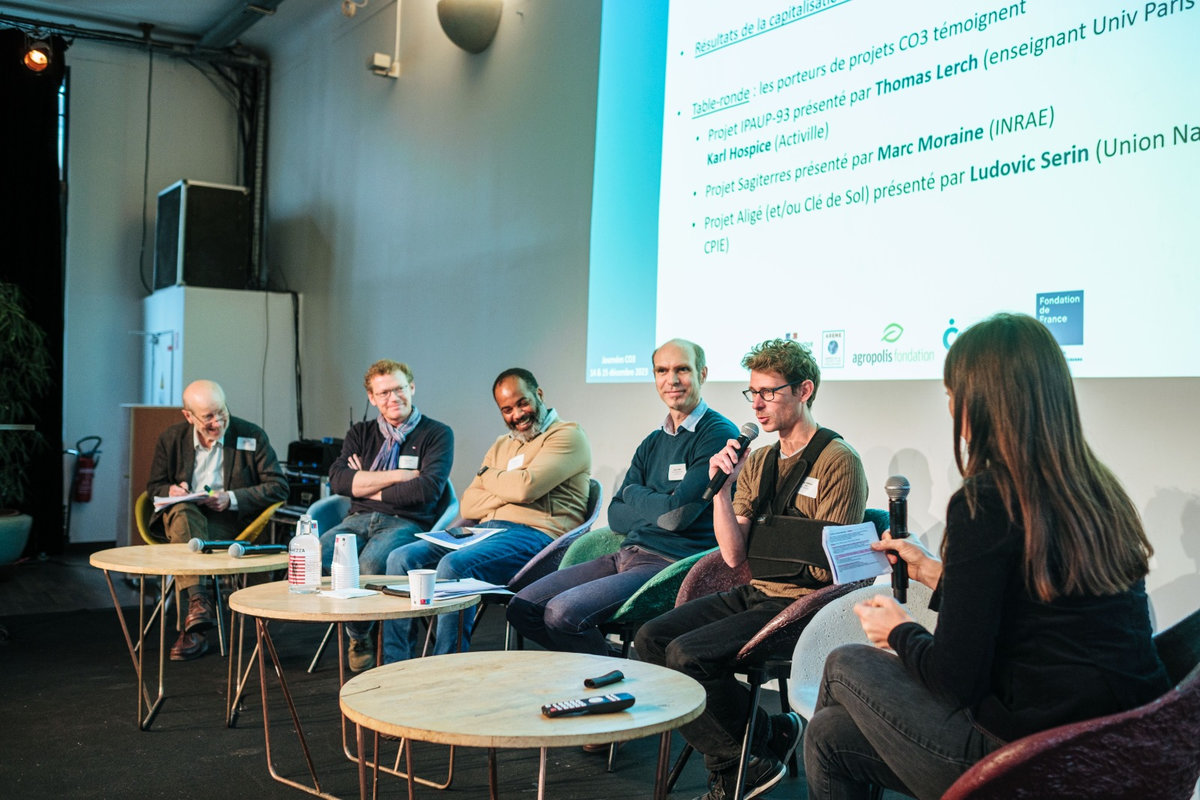
The CO3 program, which stands for “co-constructing knowledge for an ecological and inclusive transition”, was created in 2018. It is jointly supported by Fondation de France, ADEME, Fondation Daniel et Nina Carasso, Agropolis Fondation and Fondation Charles Léopold Mayer pour le Progrès de l’Homme. Its vocation is to initiate collaboration between researchers and players in the field (associations, local authorities, social and solidarity-based businesses) with the aim of promoting innovative solutions, derived from participatory research, to meet the challenges of the ecological and solidarity-based transition.
LEVAINS
BioCIVAM 11
BRETAGNE, OCCITANIE, RHÔNE-ALPES
Fermented products, such as bread, have been part of the human diet for thousands of years and are emblematic of the culture of many countries. Global changes and non-communicable diseases linked to modern diets have led to a renewed interest in fermented products and their local production, including sourdough bread. Faced with the standardization and homogenization of baking practices, the sustainability and development of the sourdough bakery sector must rely on several factors: the production of local cereals, the diversity of flours and milling types, the microbial diversity involved in fermentation, and the need for knowledge about the factors involved in the nutritional and organoleptic values of sourdough bread. Little is yet known about how the diversity of baking practices and the taxonomic diversity of sourdoughs can affect the functioning of sourdough and the nutritional and organoleptic quality of breads. The aim of this project, which brings together bakers, network leaders and researchers, is to share knowledge and questions about natural sourdough fermentation, and to support the development of the low-input natural sourdough bakery sector.
The Future of Peasant Agroecology in Occitania (FAPO) 2050
CIRAD – UMR ART-Dev
OCCITANIE
The aim of the FAPO 2050 project is to identify the conditions for the development of peasant agroecology in Occitania in 2050, through the implementation of a citizen-based prospective approach. The project responds to the challenge of agro-ecological transition and its territorial dimension.
This translates into two research questions:
- how to characterize the diversity of agro-ecological models?
- how can we model development conditions and transformation paths towards the future of peasant agroecology?
FAPO is experimental in nature, and aims to produce methods for mobilizing a network of multi-situated stakeholders in a participatory research process, and assessing the effects of stakeholder involvement in citizen foresight. The project brings together three partners: the InPACT Occitanie network of 9 farmers’ associations, UMR ART-Dev, which will coordinate a network of 15 researchers from the region, and SOLAGRO, recognized for its experience in foresight modeling. It will benefit from the support of Trait d’Union, MSH-Sud’s science-society workshop, as a third-party watchdog.
https://umr-territoires.fr/projet_du_labo/fapo/
AGRI-CO Collaborative Agriculture. New forms of exchange and mutual aid
CIVAM de Valençay et du Pays de Bazelle
CENTRE-VAL-DE-LOIRE
In partnership with GERDAL (Groupe d’Expérimentation et de Recherche : Développement et Actions Localisées), this Valençay CIVAM project, entitled “AGRI-CO: Agriculture Collaborative. New forms of exchange and mutual aid”, was born out of a reflection on the current issues and problems facing our region: an aging farming population, the isolation of farmers, their difficult access to information, the introduction of new exchange and sharing technologies illustrating the 2.0 mutations of the profession. AGRI-CO is therefore a project that aims to understand the correlation between farmers’ socio-professional dynamics, changes in their social ties, and the region’s agricultural dynamics, changes in farms and farmers’ innovations. This year-long sociological study is punctuated by interviews with male and female farmers, as well as discussion and training sessions. The web of diverse networks that will be mapped out, and the results of the final study, will shed light on the brakes and levers of a farming collective in taking initiative and generating innovation. The aim of this project is to provide the research community dealing with changes in agricultural collectives with relevant scientific results that can be directly appropriated by socio-economic players, by experimenting in a region with no precedents in this field: the Indre.
SagiTerres
INRAE – INNOVATION
OCCITANIE
The SagiTerres project aims to co-produce knowledge on agroecological transition by studying collective strategies for resource exchange between livestock and agricultural professionals in the Minervois region. In this region, which is mainly specialized in viticulture, agroecological models are emerging based on the integration of organic arable, viticulture and livestock farming systems. Various organizational methods are being developed to facilitate these exchanges between men and women farmers, and thus perpetuate agricultural activities and their complementarities in the region. This project is a continuation of the emergence project of the same name, which helped to clarify certain forms of agriculture-livestock integration deployed in the area, the organizational methods implemented, and the issues involved in consolidating and sustaining these collective strategies for territorial agriculture-livestock integration. The consolidated SagiTerres project aims to go even further, both in the analysis of collective initiatives and in the involvement of local players. The aim is to strengthen and develop these collective strategies by co-designing territorial scenarios involving different forms of agricultural-livestock integration in their biotechnical and organizational dimensions, and different collectives and stakeholders in the area concerned.
Hmm Lab
INRAE – UMR AGIR
OCCITANIE
The Hmm Lab began its development as part of the PSDR ATARI project on the rural territory of the Ariege Pyrenees in January 2019. The implementation of an initial “Positive Food Families” challenge by Bio Ariège-Garonne and the PNR showed that food practices change as a result of social learning associated with experience and exchange. This first experience led to the proposal to build a living-lab to perfect this experiential process, proceeding in iterative loops punctuated by reflective workshops and research inputs. The Hmm Lab is designed as a space for citizen experimentation to change and/or consolidate sustainable food and farming practices in a rural area. Backed by the Projet Alimentaire Territorial des Pyrénées Ariégeoises, it is the factory of a local, sustainable agri-food system. It offers people living and working in the area the opportunity to step back, debate and design their agri-food transition.
The Hmm Lab’s ambition is to function as a community of inquiry capable of overcoming this doubt by building a desirable future that is achievable by all. In other words, it’s about prototyping a food democracy.
PET – RexTri
UPC – UPC
HAUTS-DE-FRANCE
The TEP – Rex Tri project aims to support the development, facilitate the coordination and strengthen the viability of local experiments in ecological and social transition of the territory in line with the needs expressed by the populations concerned, focusing on the conditions for empowerment (food, housing, education, mobility, access to energy…). The syncretic case of the Trichon farm provides an opportunity to study the conditions for building a shared culture of ecological transition, based in particular on strong social and ecological concerns. The aim is to contribute to the democratization of these experiments, in order to help empower the most disadvantaged sections of the population and thus contribute to the creation of a popular ecological transition. The question of food will serve as a common thread for examining the possibilities of transforming social and ecological practices.