


Context and purpose
Red ACTS was born from the need for a cohesive convergence between the artistic and scientific community and citizens to face the uncertainties of the future. Its objective is to promote research, production, promotion and dissemination of projects, devices or initiatives located at the intersection of these fields of knowledge. This initiative is part of the Citizen Art axis of the Daniel and Nina Carasso Foundation, which accompanies processes that connect artistic practices, research and society.
This approach involves the creation of new forms of artistic expression in relation to scientific and technological advances. It also explores how art can influence scientific and technological development and how, from this hybridization, it is possible to address current problems and challenges.
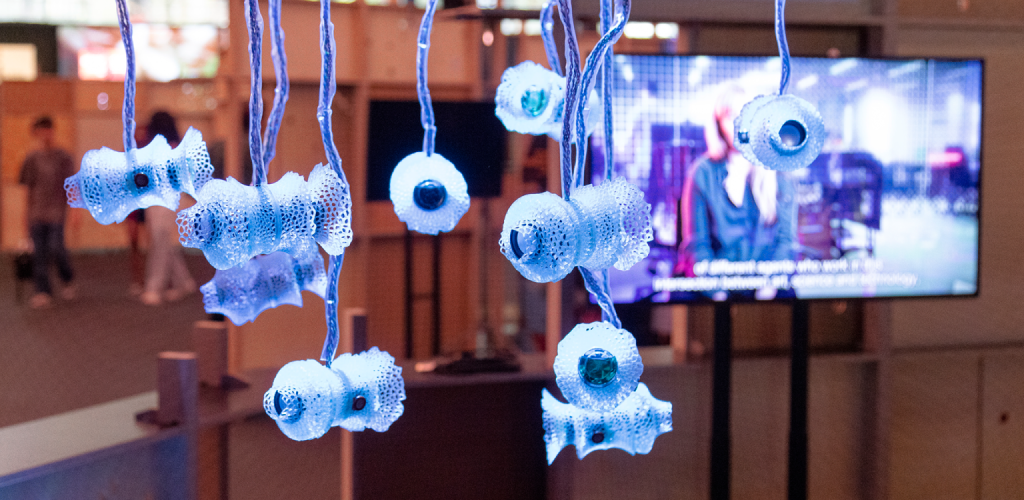
Expositor tecnológico en el festival Sónar+D que muestra avances en inteligencia artificial.
Territorial structure and organization
The network is organized through interconnected geographical nodes that act as research centers and spaces for the production and dissemination of initiatives. Its function is to facilitate the creation of synergies between local, regional, state and international contexts and to strengthen the alliances generated.
It is currently composed of four nodes:
-
Barcelona/Catalonia, coordinated by the UOC, Hac Te, Hangar and the Centre de Cultura Contemporània de Barcelona (CCCB).
-
Donostia/Euskadi, where Tabakalera and the University of the Basque Country (UPV-EHU) are the institutions in charge.
-
Valencia, promoted by the Universitat Politècnica de València and other cultural centres.
-
Madrid, with the Carlos III University.
Each node articulates territorial work and contributes to the development of initiatives and links between communities.
Specific activities and objects
Red ACTS functions as an expanded laboratory for experimentation and learning on a statewide scale. It articulates the resources and knowledge of the communities to generate alliances, promote initiatives and produce methodological devices.
Since 2023, it has had a series of pilot projects based on a methodology framed in participatory action research (PAR), aimed at cross-referencing knowledge, experiences and research results.
The pilot projects are:
Expected impact
The project proposes the articulation of shared resources and knowledge as a basis for the development of collaborative practices and the creation of common methodological tools between disciplines and territories.