9 janvier 2025
Water at the centre of the 2025 call for projects “Composing knowledge to imagine a sustainable future”


Water is at the heart of major challenges for humanity and ecosystems. The effects of climate change, overexploitation and pollution are jeopardizing this vital element, exacerbating tensions around its management. To escape the feeling of powerlessness in the face of alarming diagnoses, to sketch desirable and sustainable futures, artists are implementing new working methods in synergy with researchers, local communities, intellectuals, care, social and environmental actors.
Thus, the 7th edition of our call for projects “Composing knowledge” is dedicated in 2025 to collaborative artistic initiatives including science, empirical knowledge and cultural disciplines, focused on water preservation. The objective is to build new imaginaries allowing citizens to engage in the ecological transition made necessary by the new climate regime. We are looking forward to your projects in the form of a note of intent by February 28, 2025!
See you on Wednesday, January 22, 2025 from 12:30 p.m. to 1:30 p.m. to discuss with the Citizen Art team during a webinar.

Encourage civil society awareness of water conservation
While the international community pays some attention to water conservation – as evidenced by the 3rd United Nations Ocean Conference to be held in June 2025 in Nice – we want to encourage the awareness and involvement of civil society, by supporting artistic projects that take this issue into consideration. Water is essential to many sectors, including agriculture, which uses about 70% of the world’s freshwater consumption. From the Breton coast to the Alpine mountains and the great cereal plains, all territories are concerned. Through emotion and imagination, art sheds light on the consequences of climate change and human activity on water resources (rising waters, insufficient rainfall, melting glaciers, pollution linked to agricultural activity). In a context where water governance is crucial, art offers unique perspectives to redefine our connections to this vital resource and encourage sustainable actions.
Responding to the challenges of sustainable food and agriculture through citizen art
The quality and availability of water are essential for food security. To imagine an ecological transition that takes into account the preservation, management and sharing of this resource, Citizen Art acts as a catalyst by promoting cooperation between artists, scientists and local communities in participatory approaches; by implementing shared solutions and better ownership of the issues by all. “ The aesthetic experience offers a sensitive approach to explore issues rooted in local realities, such as access to fair food or the impact of agricultural practices on ecosystems ,” says Klaus Fruchtnis, Head of the Citizen Art France axis. As part of this call, a dozen projects will be selected: they will forge links between ecological, social and cultural issues. Through their innovative responses, they will contribute to building a food democracy where everyone can be actively involved.
Thibault Gerbail, you are in charge of the Citizen Art France programmes: for this 2025 edition, why propose a pre-selection of projects based on a note of intent?
Pre-selection by means of a memorandum of intent establishes a simplified and inclusive process, limiting the initial burden on project promoters. This allows a greater diversity of players to submit their ideas, while ensuring an initial assessment in line with the objectives of the call. This approach also emphasizes a pragmatic dimension: concentrating efforts on the most relevant proposals at the earliest stages, while giving successful candidates the time and space they need to develop their projects further.
By adopting this format, the call for projects encourages a relationship of trust with the project leaders, by recognising the value of their expertise and allowing them to refine their vision in dialogue with the Foundation. It is a balance between efficiency in selection and fairness in the opportunities offered.
Application procedures and expected criteria
This call is aimed at a variety of actors committed to the ecological transition and the preservation of vital resources, including: artists, researchers and citizen collectives; cultural institutions; art education establishments; higher education and research institutions, associations and foundations; local authorities; public institutions involved in water management.
Eligible projects must meet the following criteria:
– To take an interest in the issue of water and to propose actions or artistic performances aimed at raising awareness of its preservation
– Describe the artistic approach of the project in relation to the issue addressed
– Present a multidisciplinary team combining artists, researchers and other actors
– Explain the process of collaboration within the team and the methods for evaluating the impact of the project, with a focus on the synergy between art, science and local practices
The notes of intent are subject to a pre-selection. The pre-selected projects are then solicited for the submission of a funding application and for an in-depth analysis. All criteria, information and practical questions are presented in the framework note to be downloaded at the bottom of the page.
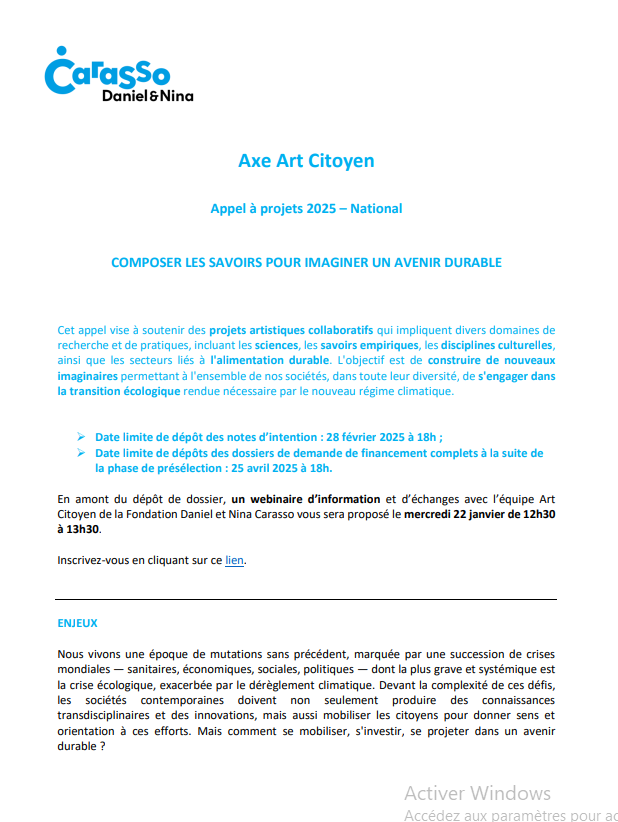
Download the framework note
9 jan. 2025 · PDF 302 KB
Submit the note of intent of your project on our dedicated platform.
Credit: Glass Chain – Vincent McClure