22 mars 2021
Opening of the call for projects “Composing knowledge to imagine a sustainable future”


For the 5th edition of “Composing Knowledge”, we encourage artistic projects that involve several fields of research and practice in order to build new imaginaries that allow our societies to engage in the ecological transition. Apply until June 25, 2021!
Citizen Art, mobilizing in the face of the ecological crisis
We are living in an era of unprecedented change, marked by the appearance of successive crises on a global scale – health, economic, social, political crises – the most serious and systemic of which is the ecological crisis, including climate change. Despite the flow of information and data we receive, it is becoming increasingly difficult to understand their interconnections. Waves of images of natural disasters, population movements, alarming statistics, etc., flood us without being able to offer us a horizon beyond the spectacle and experience of a generalized disaster.
Faced with these complex challenges, we are convinced that art must fully play its role as a citizen catalyst to help us imagine a sustainable future and trigger positive affects. The work of artists is immense in apprehending and representing this new reality in constant mutation, as well as that of scientists, philosophers and finally all citizens who must orient themselves and our collective choices.
Arts and Sciences to Imagine a Sustainable Future
Convinced that the era we are living in calls for a transdisciplinary approach through the mobilization of the creative forces of the arts and sciences, in 2015 we initiated the call for projects “Composing knowledge to better understand the challenges of the contemporary world” as part of our Art, Science and Society program.
It has made it possible to identify and support numerous cooperation projects between artists and scientists who are experimenting with other ways of understanding current phenomena. We are thus seeing the emergence of projects around climate change and the ecological crisis. To emancipate themselves from the feeling of powerlessness generated by the repetition of hopeless diagnoses, to sketch desirable and sustainable futures, artists are initiating new working methods and becoming more involved in synergy with researchers, inhabitants of a territory, intellectuals, associative actors, professionals in care, social affairs, the environment…
Because the ecological crisis is also a crisis of sensitivity, representation and imagination that encourages collective mobilization.
Thus, the 2021 call for projects is oriented more specifically on the ecological crisis and aims to support artistic projects that allow our societies to engage in the transition imposed on us by the new climate regime.
Among the expected criteria, these projects:
- Bring together a multidisciplinary team (artists, researchers, institutions and educational establishments, associations, foundations or local authorities)
- They may concern different fields: visual arts, music, architecture, design, performing arts, etc., other knowledge, empirical, secular, artisanal, culinary, agricultural, etc., basic and experimental sciences, human and social sciences
- Commit to the eco-design of production and public distribution by integrating environmental aspects (responsible purchasing, waste management, digital sobriety, mobility-transport, reduction of carbon impact, etc.);
The projects are selected by a jury composed of qualified personalities. Our teams support project leaders within the framework of rigorous monitoring and a human relationship based on trust.
We offer many opportunities for meetings, exchanges and promotion, whether through seminars, evaluation work, publications or major events such as the Franco-Spanish General Assembly of Knowledge Composers, organized in 2018 at the Cité internationale des arts.
3 questions to Anastassia Makridou-Bretonneau, Head of the Foundation’s Citizen Art axis
What is your assessment of this call for projects?
When we created it in 2015, collaboration between artists and researchers still seemed like a fallow field to explore. During these 5 years, we have been able to observe that a significant number of initiatives exist in all areas of the arts and sciences, creating original, unexpected synergies between, for example, theatre and marine biology, dance and neuroscience, or visual arts and artificial intelligence or astrophysics… They broadly embrace the challenges of our world: climate change, migration, the acceleration of knowledge, resource management, geographical and economic inequalities.
Are there any changes this year?
There is no revolution but a notable evolution this year because we exclusively target artistic projects that allow us to imagine a sustainable future, to situate ourselves in the reality of interdependence and to desire other ways of inhabiting the Earth, our common and unique home. The Daniel and Nina Carasso Foundation has been committed to this subject for a long time through its two axes, Sustainable Food and Citizen Art. Moreover, the global shock that the health crisis represents leads us to think that it is an epiphenomenon, revealing a broader and systemic crisis, that of ecology. Art is a powerful engine to metabolize what happens to us, not to imprison ourselves in a feeling of fear and guilt. More than ever, we need a positive and resilient imagination!
What will be your analysis of the applications?
Given these challenges, we will be very attentive to the dissemination of artistic projects. Many initiatives are confidential, which is naturally explained by their hybrid and unclassifiable nature. Whatever the production envisaged, we encourage the actors to strengthen the links with the public. Scientific discoveries are abundant in all fields and reveal new realities to us. Artists have this unique ability to transform reality into poetic representations, which allows us to mobilize our imagination as well as our reflection, in other words to apprehend it in a sensitive and critical way at the same time. Far from the image of an individual isolated in his ivory tower, the artist is turned towards the world and others, as shown by the artists involved in all our projects as well as the winners of our new Committed Citizen Artist Award. I am confident that our call for projects will support high-quality artistic projects.
Application procedures, criteria, selection method... All the information on how to apply is available here

Download the framework note
Composing knowledge to imagine a sustainable future
22 mar. 2021 · PDF 666 KB
Download the Press Release
Call for projects “Composing knowledge to imagine a sustainable future”
22 mar. 2021 · PDF 628 KB
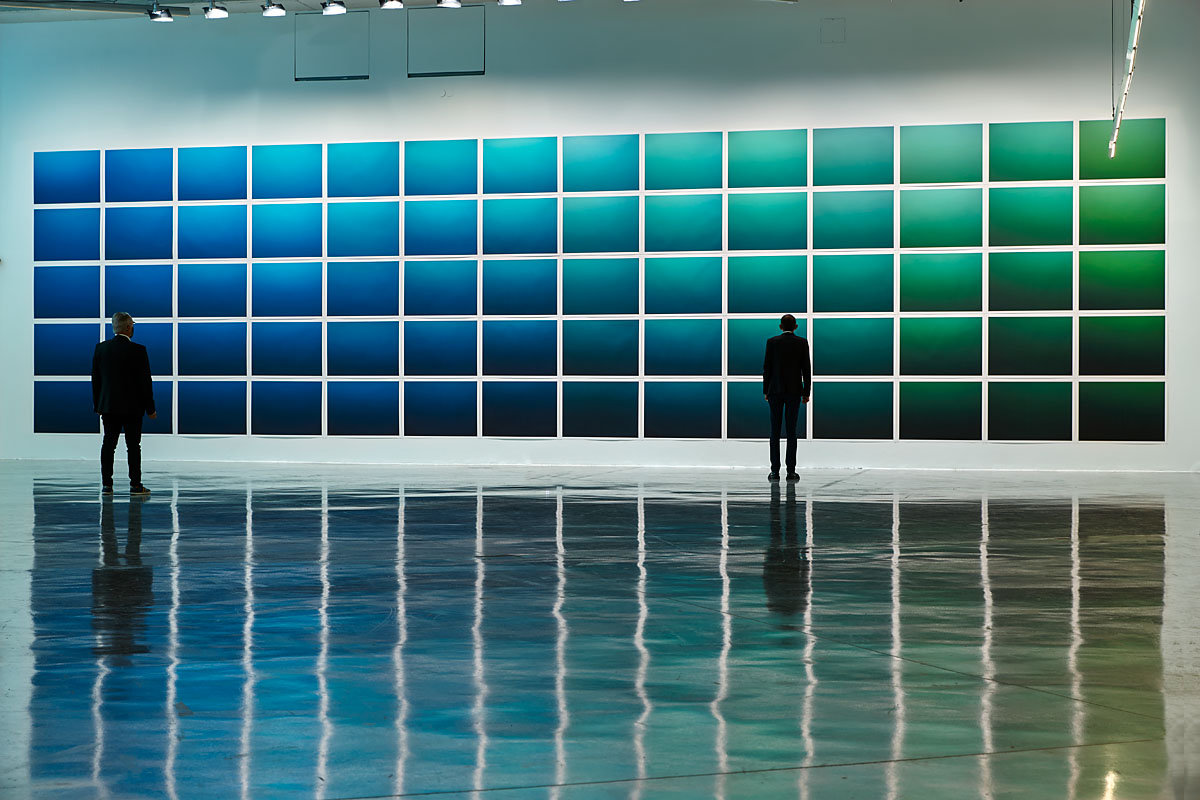
Photography: © Nicolas Floc’h, The Colour of Water, 70 photographs, Frac Paca, 2020 https://www.fracpaca.org/Nicolas-Floc-h-Paysages-productifs (exhibition ©view Laurent Lecat) Project supported as part of “Composer les Savoirs” 2019: led by Art Connexion https://www.artconnexion.org, this project is a continuation of the Les travailleurs de la mer programme, bringing together scientists and artists at the Wimereux marine station. Hubert Loisel (researcher) and Nicolas Floc’h (artist) have worked on the colour of water to understand and characterise, on a large scale, the biological variations of the environment. https://www.nicolasfloch.net