22 février 2023
“Learning” notebook: Composing knowledge to better understand contemporary issues


In Madrid, Barcelona, Murcia, Cadiz, Nantes, Marseille, Strasbourg, Annecy, Bourges… Artists, scientists and citizens are combining their skills around issues for which a field of knowledge can no longer provide relevant answers on its own. Supported in their approach by our Foundation, they have experimented with new forms of action and research to respond to contemporary challenges: oceans, forest management, the collapse of the Alps, waste treatment, health, migration, international justice, education, disability, etc. After 6 years of supporting these citizen projects combining the arts and sciences, we are publishing a new Notebook from our “Learnings” collection in order to better understand the conditions of their realization and share their experiences.
Carasso "Learning" notebook
Composing knowledge to better understand contemporary issues
22 fév. 2023 · PDF 27 MB
The alliance of arts and sciences
Through our Citizen Art axis, we support actors – artists, educators, scientists, mediators, associative teams, local authorities, etc. – who make art a driver of citizenship to develop a sensitive and critical view of the world and strengthen the cohesion of society while respecting diversity. Our ambition is to contribute, through our programs, to building a project for the future that takes into account the needs of human beings but also the fragility of our environment. The complexity of the challenges we have to face requires us to invent other ways of living and doing, more collective, more courageous, to create synergies, to engage in real cooperation.
Our call for projects “Composing knowledge to imagine a sustainable future”, launched in 2021, is a continuation of the call for projects that we created in 2015 to support transdisciplinary projects, bringing together artists, scientists and sometimes representatives of civil society, on important, even urgent, issues of our contemporary world.
After six years of exploration of a very vast field with variable interpretations, known under the generic name “arts and sciences”, it seemed necessary to carry out an in-depth investigation to better understand its contours. Based on a selection of projects, the objective of this work led by Valérie Pihet, Maria Ptqk, Anne-Françoise Raskin, Mari Linmann, Victoire Dubruel and Miguel Alvarez-Fernandez, was to analyze their conditions of implementation and to collect the main learnings from those who were involved.
«
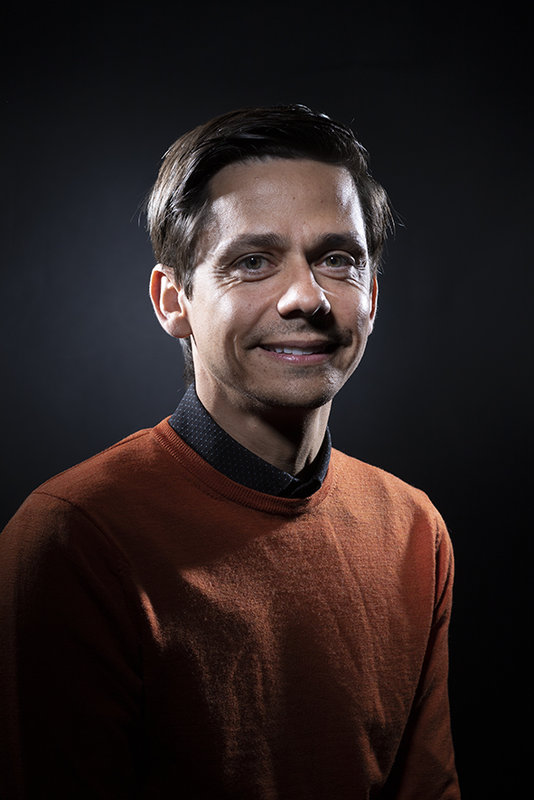
The work of composition teaches us to think of our knowledge as connected. They are neither autonomous nor interchangeable, but connected, and it is their alliances that make them capable of intervening in a transformative way in reality, this is the common thread of our program where art fully plays its role as a citizen.
»Klaus Fruchtnis, Head of Citizen Art France
Citizen projects that imagine a tomorrow that is as sustainable as it is desirable
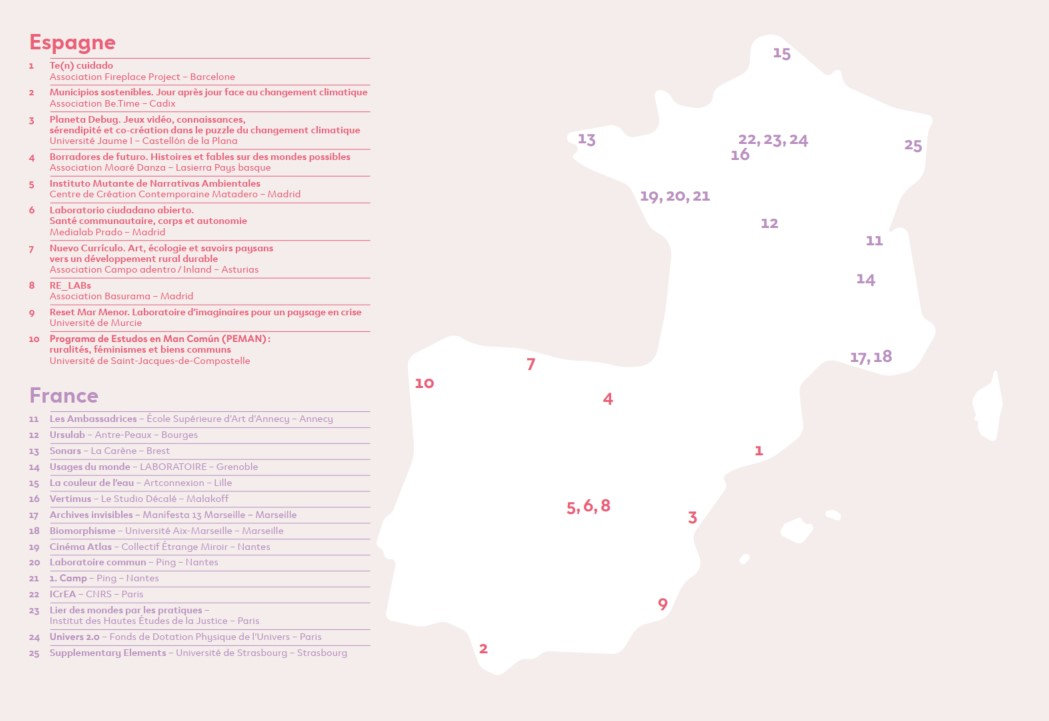
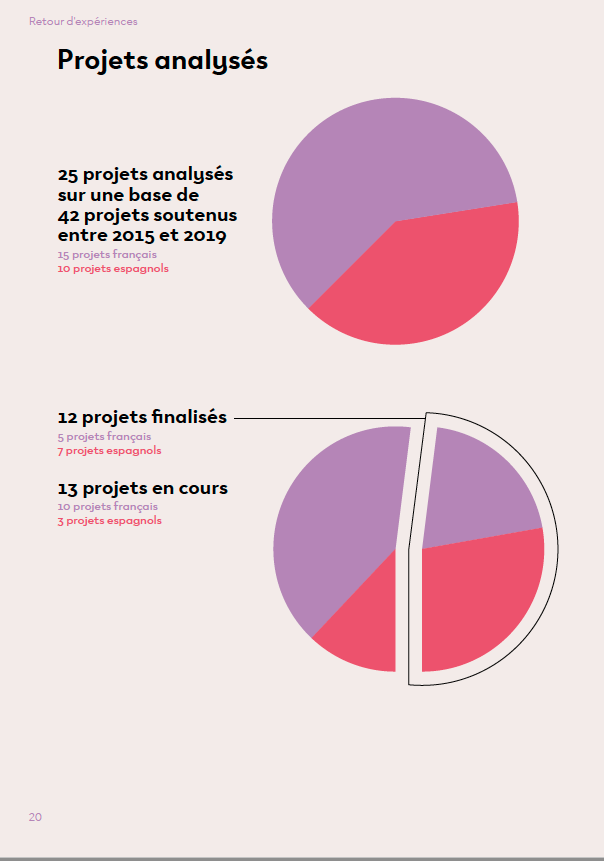
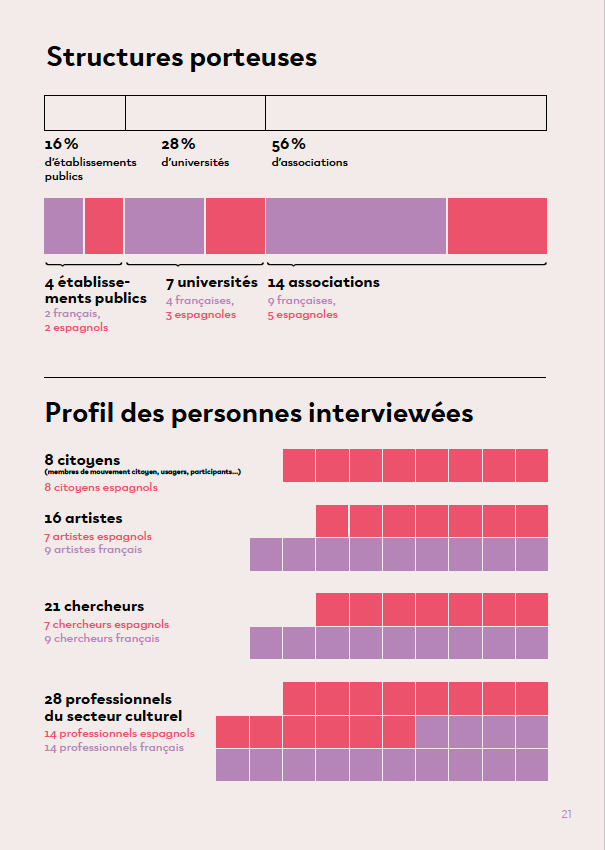
This new Notebook in our collection dedicated to learning, provides keys to understanding the composition of knowledge through the course and in-depth analysis of 25 projects carried out in France and Spain. All these “composers of knowledge” testify to the vitality generated by the projects in which they take part and underline the need to support and accompany them. Stepping out of routines to meet other experiences stimulates curiosity, the desire for discovery and the appetite to continue learning, which can be found in the inventiveness deployed by each project to expand our knowledge of the world. The commitment of the teams and actors in this investigative work is commensurate with the risk taken by the Foundation, that of experimentation. We would like to thank them warmly.
Contents of the Notebook
- State of play
- Feedback: Analysis of 25 projects between France and Spain
- Cultivating a Common Language: From Dispersed Interests to a Shared Culture
- Towards an ecology of practices: Decompartmentalizing and de-hierarchizing knowledge for sustainable change
- Creating value: Mobilizing all audiences around the composition of knowledge
- A conclusion that is not a conclusion: Multiply perspectives to broaden our knowledge of the world
- Learn more: Knowledge Composition Compass, Project Summaries
Issues discussed during a webinar
On Tuesday February 21, we brought together 8 representatives of projects supported in France and Spain to talk about their experiences in a webinar open to all. Why is knowledge composition essential today? How do they decompartmentalize knowledge? What do they have in common? What value do they produce within and beyond the collective? In what way do they relate to citizen art? This rich exchange with 178 participants highlighted the role of art as a critical activity and as a creator of new imaginations, both of which are essential for reinventing our individual and collective ways of living and thinking. These projects have shown us that art is not only a tool for investigation, but also for research. Marie-Stéphane Maradeix, General Delegate, and Isabelle Le Galo, Deputy Delegate for Spain, reminded us that ” it is essential to develop dialogue between artists and scientists. This is why we are attentive to these innovative projects, as well as to events and any other means of dissemination that highlight the potential of this hybrid research and make it accessible to the general public. ” The meeting was also an opportunity to present thecall for projects open until March 31, 2023 to encourage new initiatives. Pepa Octavio, and Klaus Fruchtnis, responsible for the Citizen Art axis in Spain and France, concluded that ” the evolution of these crossovers and their potential to inspire and inform each other were illustrated by the projects presented during this webinar. And it is precisely this cross-fertilization between disciplines that enables us to develop empathy, an essential feeling for identifying with others. »