Socially engaged art
06 May, 2024
Vibras, rhythm for community development in Usera and Carabanchel


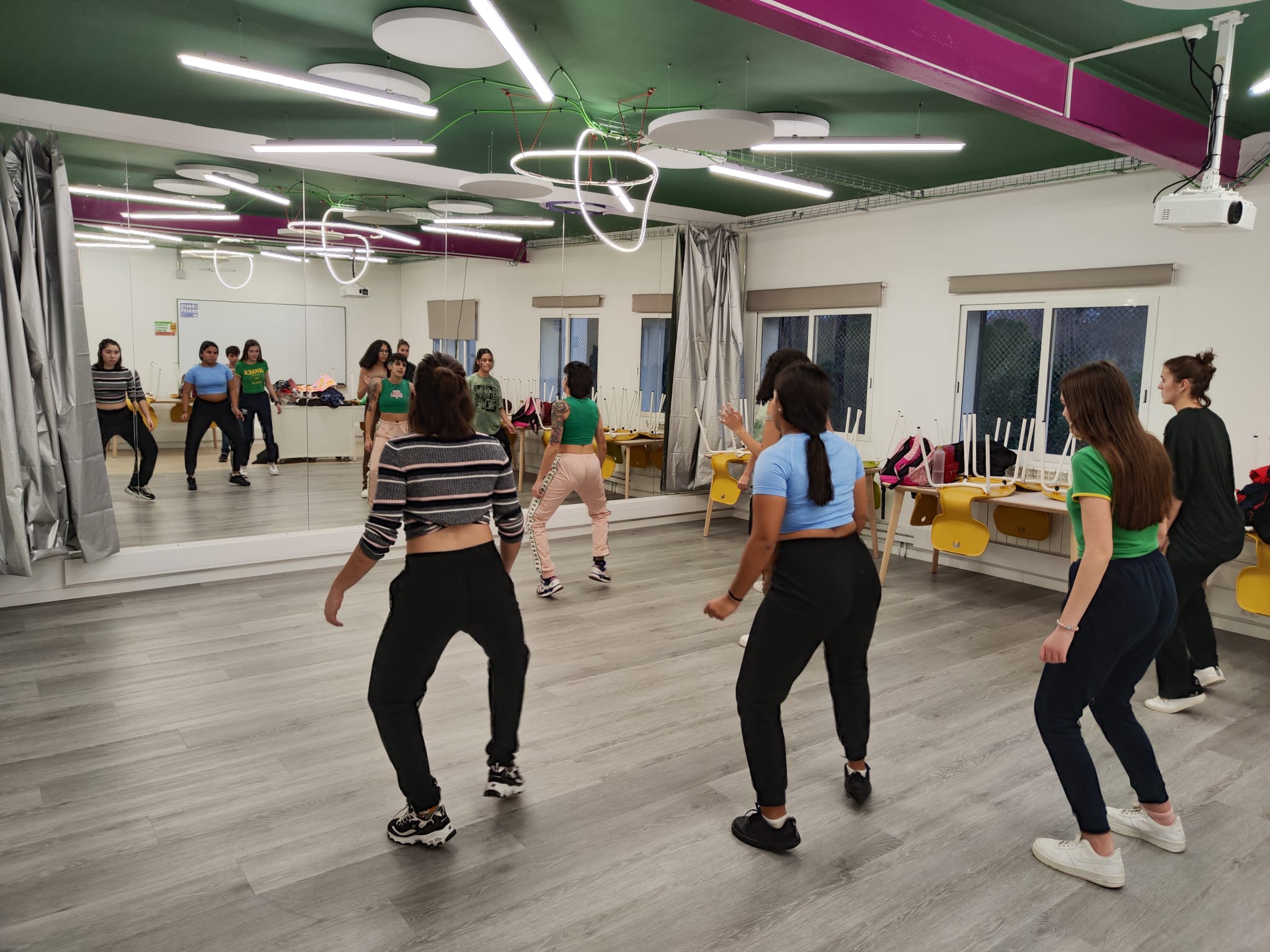
The Vibras project, promoted by the alliance between the Tomillo Foundation and the Kubbo Association, is a vibrant artistic and cultural mediation space. Through dance and urban culture, a group of young people, through experimentation and creative expression, are opening their eyes to eco-social transformation. The initiative was selected in the last edition of the Daniel and Nina Carasso Foundation’s Alliances for a Cultural Democracy call, aimed at projects that arise from alliances between various agents and that promote full participation of citizens in cultural life.
The Tomillo Foundation and the Kubbo Association seek, with the Vibras project, to generate a space for community development in the Madrid neighbourhoods of Usera and Carabanchel through artistic creation. To this end, the project is organised around five itineraries (musical creation, freestyle, urban dances and music school) that facilitate work with young people in transversal skills such as critical thinking, collaborative work, self-knowledge, active citizenship, etc.
To inspire other similar projects to participate in the new call for Alliances for a Cultural Democracy, open until May 16, we spoke with Tomás Borgogna, head of the Pedagogy and Methodological Development Unit of the Tomillo Foundation.
How did you find out about the Alliances for a Cultural Democracy call and what has it meant for your organisation to have the help of the Daniel and Nina Carasso Foundation in this initiative?
Fundación Tomillo has been involved in projects focused on promoting sustainable and healthy eating. These experiences have allowed us to be aware of other opportunities, such as the call Alliances for a Cultural Democracy, offered by the Daniel and Nina Carasso Foundation.
Why would you encourage other initiatives to apply for the new call for Alliances for a Cultural Democracy? What unique opportunities do you see in it for those who participate?
At Fundación Tomillo, we recognize that calls such as Alliances for a Cultural Democracy are exceptional opportunities that we should not overlook. Participating in this call is more than just an application, it represents an exceptional opportunity that we should not miss. It gives us the possibility to strengthen our artistic work, expand our impact and, at the same time, maintain the quality and authenticity of our proposals. It is a crucial moment to demonstrate how art can enrich the lives of young people and contribute to the development of a more creative and participatory society.
Tell us where the Vibras project was before joining Alliances for a Cultural Democracy 2022. What was the pre-existing relationship between the members of the alliance? How did you approach the project? Were activities being carried out previously?
For the last two decades, Fundación Tomillo has been immersed in the development of its own project focused on the performing arts. Although the arts have been a constant in our work, the main focus of our action has been predominantly socio-educational. We have focused on the implementation of various artistic disciplines with the aim of facilitating group connection and establishing a safe place of reference for young people in Usera. Our goal was to provide a space where they felt welcomed and had the freedom to express themselves..
After this experience, we have co-designed with Kubbo the Vibras proposal, which allowed us to participate in the previous edition of Alliances for a Cultural Democracy. This collaboration has been an important step in our journey towards integrating a more artistically focused perspective.
How did the alliance with the Kubbo Association come about and what lessons have you been able to draw from this collective experience?
Prior to Vibras‘ experience, he had collaborated with Kubbo to integrate artistic work with the body into some physical education classes aimed at young people in vocational training. Although this collaboration was limited in scope, the results were positive and motivated us to think together about a proposal for Vibras. The alliance with Kubbo, our partner in this project, has been essential to open a space for reflection and reorientation on the importance of the arts in our work.

We are convinced of the importance of facilitating access to quality artistic proposals for groups that are normally excluded from them. This becomes a way of fully exercising citizenship.
Thomas Borgogna
Head of the Pedagogy and Methodological Development Unit of the Tomillo Foundation
Tell us more about why it is ideal to work with young people from artistic creation
Prior to Vibras‘ experience, he had collaborated with Kubbo to integrate artistic work with the body into some physical education classes aimed at young people in vocational training. Although this collaboration was limited in scope, the results were positive and motivated us to think together about a proposal for Vibras. The alliance with Kubbo, our partner in this project, has been essential to open a space for reflection and reorientation on the importance of the arts in our work.
Tell us more about why it is ideal to work with young people from artistic creation
Reflection on the role of the performing arts in the socio-educational strategy of the Tomillo Foundation has undergone a gradual evolution. Initially, we saw the arts mainly as a means to convey content aimed at improving soft skills. However, at times, the artistic quality of the proposals was not in the spotlight. Over time, and thanks to interactions with Kubbo, we have come to the conclusion that it is crucial to promote a process of democratization of the performing arts among young people in vulnerable situations.
In addition, we want to incorporate into our guidance and accompaniment model actions that allow young people to find answers to questions related to how to continue incorporating artistic disciplines into their life projects, even if they want to dedicate themselves professionally to another sector. We are working more and more to facilitate proposals that respond to these concerns, considering them as an action of democratization. The right to participate as artists should not be a privilege reserved only for the elites.
Best of all, this approach doesn’t mean undoing what we’ve been doing before. The arts continue to be a language that allows us to work from a socio-educational perspective, promoting self-knowledge, empathy and other important skills.
What transformative mediation methodologies are you using to develop the project?
The project has focused on the internal transformation of the entity, defining more precisely what is the differential value that the Tomillo Foundation can provide with respect to the performing arts. This is in line with a process of innovation and change that we are going through at the moment, just as the entity celebrates its 40th anniversary in 2024.
Our goal is to offer a new model of intervention, closely linked to specific territories south of Madrid. In these places, we want Fundación Tomillo to be able to deploy all the integrality of the different lines of intervention in which we have specialised, offering opportunities that are interconnected with each other. In this context, Vibras is one of the proposals that make up the ecosystem we propose.
What kind of actions have been put in place around the project and what have they borne fruit?
In the first year, we carried out urban art workshops in Usera and Carabanchel, covering various disciplines such as freestyle, dance, music and audiovisual production. These workshops culminated in a series of exhibitions that were presented at the Usera Intercultural Festival, as well as at other community events, such as the UrbanFest in Usera and the UrbanFest in Carabanchel.
For the second year, we have focused the proposal on a single geographical area (Carabanchel), also carrying out reforms in the physical spaces of implementation. We have adapted a classroom by modernizing the facilities to be able to host different activities of artistic expression. We have improved soundproofing, added mirrors for dance classes and, in general, we have paid attention to creating a space that allows the development of quality activities.
We have also redesigned the project, introducing a project-based schedule that facilitates the access of new participants at different times. In addition, this new structure allows changing artistic discipline according to the interests of each participant. We have also promoted access to meaningful experiences, involving professionals in the music sector.


What would you say has been the impact that Vibras has generated in the environment of the Madrid neighbourhoods of Usera and Carabanchel, during the last two years?
In the first year, 65 young people from the districts of Usera and Carabanchel have participated, artistic pieces have been created according to the different itineraries (4 choreographies, small musical products and 4 videos), 95% of the participants state that they have improved their artistic and socio-emotional skills, highlighting the ability to understand that they can use art to express themselves. In addition, links and collaborations have been established with the Carabanchel Youth Center, the Pipo Velasco Youth Center, the Orcasur Neighborhood Association and the Orcasur Cultural Center.
In the second year, 60 young people from the district of Carabanchel have participated, artistic pieces have been created from the PBL methodology (1 short film, 1 collaborative mural, 5 choreographies, 1 rap video clip and small theatrical pieces), they have actively participated in the table of entities Mapeando Carabanchel jointly developing 3 community events. Cooperation relations have also been established with various educational centers in the district.
In addition, through the alliance with Kubbo, it has collaborated with great references in the world of Art and Culture such as SONY or Mayumana, as well as with various artists who have joined the project throughout the course, both from the world of music and dance, plastic arts or audiovisual arts.
What is the future of Vibras? Have you thought about a second phase of professionalization for the young participants?
In the future, we intend to develop two main lines within our project. On the one hand, we intend to awaken interest in young people who, due to economic reasons or lack of interest, often do not have access to artistic-cultural proposals. Our objective is to vindicate the importance of these initiatives from a perspective of citizen participation. Likewise, it is about connecting some of the expressions of youth culture as full-fledged art forms (for example, manga or graffiti or the use of social networks to socialize dance steps).
Secondly, we want to strengthen the technical-artistic skills of young people who have already identified their vocation for artistic creation, but who often lack the necessary resources to access quality training. This involves not only practical skills, but also the ability to reflect on the messages and narratives that each young artist can develop through their work, thus addressing socio-emotional aspects. In addition, guidance actions are needed to identify continuous training opportunities. In the future, we would like to offer access to scholarships and experiences with companies or artistic projects to broaden their horizons. To do this, it is necessary to connect with sponsors, artists, companies that allow us to enhance the impacts, with special reference to the quality and projection of the proposals that we will be able to develop.
What aspects do you think a person or entity embarking on an Alliances for a Cultural Democracy project should take into account? What data, keys or tips do you think would have been useful to you at the beginning of this journey, to transmit them to new projects?
From the get-go, it’s crucial to make connections and collaborate with other organizations and businesses. This allows for the creation of a shared ecosystem with a similar vision while also making it easier to connect with potential sponsors. The synergy between different actors in the artistic and educational field can be very beneficial.
In addition, it is important to note that organizations that are mainly dedicated to developing socio-educational programs have to go through a change of mentality in order to propose projects for the democratization of the arts. Traditionally, the idea was “we have teachers or educators who know about the arts”. However, we now propose a new perspective: “a socio-educational center must have artists who work hand in hand with educators.” The quality of artistic training is a relevant aspect. Sometimes, it is tempting to offer workshops that, from an educational perspective, fulfill their function, but may be limited in terms of artistic quality. This shift reflects the importance of interdisciplinary collaboration to the success of programs.
Submit your project for the call "Alliances for a Cultural Democracy"


