Socially engaged art
24 April, 2024
About Culture, how to improve the lives of people in vulnerable situations through culture


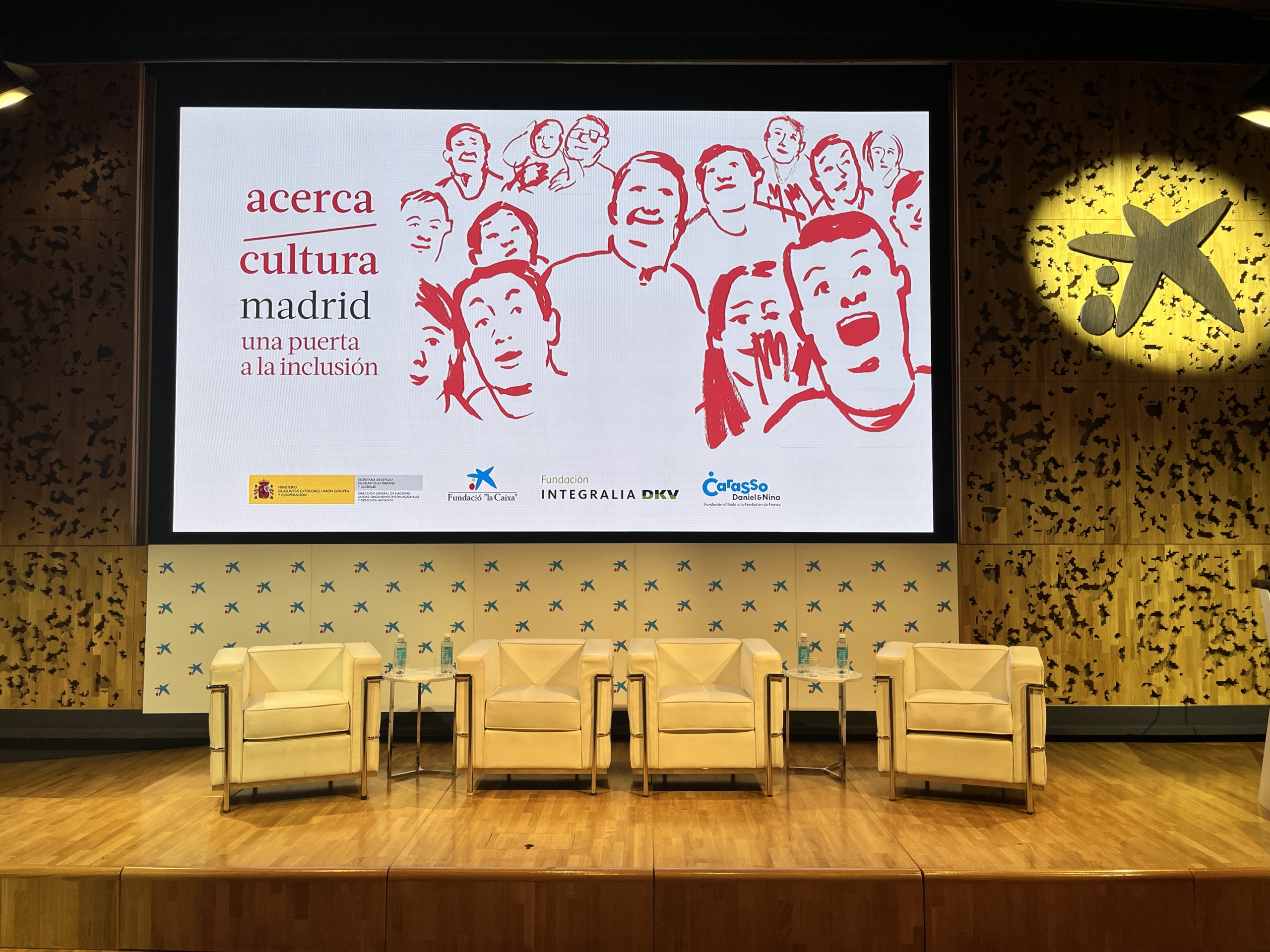
About Culture is dedicated to fostering a more inclusive and just society by using culture as a tool for social transformation. Supported by the Daniel and Nina Carasso Foundation in the Community of Madrid, this project advocates for universal access to culture, highlighting diversity as its essential foundation.
By viewing culture as a universal right, About Culture drives social and personal change, promoting diversity and inclusion in all its forms. With success in Catalonia and the Balearic Islands, and its recent expansion to Madrid, the project serves as an inspiring model for similar initiatives.
On the eve of the new call for Alliances for a Cultural Democracy, open until May 16, we spoke with Cristina Arroyo, coordinator of About Culture Madrid, to delve into how diversity is key to its strategy and the impacts generated so far.
How did you find out about the Alliances for a Cultural Democracy call and what has it meant for your entity to have the help of the Daniel and Nina Carasso Foundation to bring this initiative to the Community of Madrid?
We have known and followed all the work of the Foundation for a long time, I believe that any cultural professional knows the Foundation and dreams of being able to count on its support.
The mere fact of drafting the call already helped us to structure the programme and its methodology, and to define a calendar of action and milestones to be achieved in the first year. But, without a doubt, being selected was key to the start of the program. Not only do we have the financial resources to start it, but we started with the vision of meeting objectives and making the available resources efficient, which allowed us to have a year to grow the network of collaborating entities and look for more ways of financing to make the program sustainable.
Tell us where the About Culture Madrid project was before joining Alliances for a Cultural Democracy 2022. What was the pre-existing relationship between the members of the alliance? How did you approach the project? Were activities being carried out previously?
The launch of the 2022 call for Alliances for a Cultural Democracy coincided with the time when we were starting About Culture Madrid, so we didn’t hesitate for a second when we saw them. The program was in a phase of adapting the methodology and presenting it to cultural and social entities that we previously knew that wanted to be part of the network. Applying for the call allowed us to give structure to what we were offering to the entities in terms of dates and activities and allowed us to create a first network of cultural and social entities that committed to participate in the program in a first pilot phase.
How did the alliances with the Consorci de l’Auditori i l’Orquestra, the La Caixa Foundation, the Psychiatry and Life Association, the Full Inclusion Madrid Federation and the National Drama Centre come about? What lessons have you been able to draw from this collective experience?
The Consorci de l’Auditori i l’Orquestra is the intellectual owner of the Apropa Cultura program and they were the ones who contacted us, the Hazlo Accesible Association, to sign an agreement by which they gave us their methodology, technology and knowledge to implement the program in the Community of Madrid. The “la Caixa” Foundation had been committed to the programme in Catalonia for years and they also decided to support the start of the programme in Madrid. We already had previous contact with the Psychiatry and Life Association, Full Inclusion Madrid and the National Drama Center for other programs and projects, so we went to tell them about the program to propose joining the network.
Tell us more about why the need to scale the initiative from Catalonia and the Balearic Islands to Madrid was seen
About Culture is a program that works to guarantee the rights of access and participation in culture of people with disabilities and people in vulnerable situations. It is a transversal program since it defends and works for the cultural rights of all people and its methodology can be implemented in any territory, so that it benefits anyone. In some forums and meetings, some cultural entities located in the Community of Madrid had shown their interest in the program, so in 2022 it was decided that it was time to move it, since in 2021 the same tour had been made in the Balearic Islands and the experience had been very satisfactory.

About Culture has a maxim: access to culture is a right, it dignifies the person and normalizes their full inclusion in society. Inclusion is not only being in spaces, but also feeling them as one’s own and being able to participate in them and in the activities they offer.
Cristina Arroyo
Coordinator of About Culture Madrid
What transformative mediation methodologies are you using to develop the project?
Our methodology is constantly being reviewed, since, thanks to the joint work with the professionals of the social entities, we put people at the centre and we are constantly actively listening to what they need, what they want and what barriers they still encounter today to access and participate in the standardised cultural offer of their territory.
What kind of actions have been put in place around the project and what have they borne fruit?
We have a platform that allows us to mediate between cultural entities that want to offer their usual offer to people with disabilities and people in vulnerable situations, and the social entities that work with these people and that can help transmit this information about the available offer and also promote their interest in artistic disciplines that may generate less curiosity or that they have never enjoyed. The fact that the programming is on this platform allows people themselves to decide where and when they want to go, depending on their interests and tastes.
We highlight, in each offer, the physical, sensory and cognitive accessibility measures available as well as other aspects that could be critical or sensitive for the people who are going to attend, such as duration, light effects, noise level or explicit content of sex and violence. In addition, the cultural entities of the network undertake to block 2% of the capacity of their usual functions and activities for the people to whom the program is directed, and limit the maximum price to €3.
We also train professionals from cultural entities in basic aspects of inclusion, how to improve interaction and communication with people with disabilities and in vulnerable situations when they come to their spaces, and in the physical, cognitive and sensory accessibility measures that can be implemented.
Finally, we also hold conferences on good cultural practices in inclusion and accessibility, and on cultural rights, which are open and free of charge for anyone interested.
What would you say has been the impact that About Culture Madrid has generated during the last two years?
At present, at Acerca Cultura Madrid we have a network made up of 24 programmers and cultural spaces and 235 entities, centres and social services. Since July 2022, more than 4,500 people with disabilities and in vulnerable situations have enjoyed the usual cultural offer offered by these programmers and spaces, often being the first time they have had the opportunity to enjoy a play, a dance show or participate in a guided tour of a museum.
But the programme also has an impact on the professionals who are part of the network, allowing them to approach inclusion from a more strategic point of view and consider these people as full-fledged audiences, which influences all areas of the value chain and the cultural experience.
For social action professionals, this programme contributes to achieving the goals of full inclusion that everyone pursues, but also to working on specific aspects in the programmes and intervention processes they develop with people.
And, linked to the above, there is a lack of training on diversity, inclusion and universal accessibility in the cultural sector so that professionals in cultural creation, dissemination and exhibition centres take into account all people, with their different characteristics and their different needs, so that they can be creators and audiences of culture in their own right.


What aspects do you think a person or entity embarking on an Alliances for a Cultural Democracy project should take into account? What data, keys or tips do you think would have been useful to you at the beginning of this journey, to transmit them to new projects?
The alliance must be the reflection of a shared project or programme, where all parties have participated in the design from their experience and knowledge in their field of action and represents all the wills and responses to the needs of all interested parties. Therefore, the alliance can start from a particular project but must allow flexibility for it to become an initiative that all parties can feel and defend as their own. As soon as someone feels that they do not participate in decision-making and/or that their needs are not being taken into account, they will drop out of the alliance and this will affect the rest.
It should also be taken into account that there will be more creative, more operational or more executive profiles. There will necessarily be a coordination profile that is as necessary as the creative profile for the project to work, and this person must assume that part of their job will be to coordinate all the wills so that the objectives are met and establish continuous communication with all the parties involved to achieve the committed milestones.
An inspiring message for those initiatives that are thinking of applying for the new call for Alliances for a Cultural Democracy?
Applying for the call is the best way to rethink a cultural project from a much broader and more transversal perspective than the individual one, which enriches the project and allows it to be structured taking into account vertices that had not been contemplated until now.
The world in which we live is very complex, the challenges we face do not usually have a single solution and at the intersection of art, culture and citizenship there are many small and atomized projects aimed at implementing the same solutions for a small group of people, which often prevents them from growing and sustaining themselves over time. Projects created in alliance have a greater capacity to be sustainable because they can face social challenges that require technical knowledge from different areas, which implies the participation of different actors, in addition to having the advantage of sharing resources and economizing efforts.
Submit your project to the call "Alliances for a cultural democracy"


