Socially engaged art
11 April, 2024
Encounters between art and school from an architectural perspective: PLANEA and Festival Concéntrico



From April 25 to May 1, 2024, the 10th edition of Concéntrico, the Logroño International Festival of Architecture and Design, will be held, an opportunity to rethink architecture from its social and human dimension. From the PLANEA art and school network, promoted by the Daniel and Nina Carasso Foundation, this reflection also builds bridges between architecture and school. Educational centres of different levels and associated cultural entities thus weave a cohesive network with the city.
For the second time, the PLANEA network collaborates with the Concéntrico Festival, to promote collective artistic practices in public space. Thus, within the framework of the tenth edition of the Festival and with the aim of rethinking and adapting the environment by, for and from learning, “Educational Spaces” will be carried out.

Architecture and art, together with education, promote transformative learning. At PLANEA, we see how the fusion of these fields motivates students to explore and rediscover their environment, fostering an education that transcends the traditional walls of the classroom.
Pedro Jiménez
Coordinator of the PLANEA network
The network works together with several international architecture studios such as Outpost Office, Alei Verspoor and the duo ji arquitectos + Blas Antón to develop specific projects. On the other hand, the students of the IES Sagasta will actively participate in one of the initiatives of The street at 10 years, carried out by the architect Dayan Knoblauch.
Projects in La Rioja to rethink educational spaces at the national level
Promoted by the Daniel and Nina Carasso Foundation, PLANEA is currently working in four territories through cultural mediation nodes: the Community of Madrid (Invisible Pedagogies), the Valencian Community (PERMEA), Andalusia (ZEMOS98) and La Rioja (CRIE). This development allows the projects that are carried out in the tenth edition of Concéntrico to be extrapolated to the rest of the nodes, thus extending in time after the festival itself. These pedagogical and co-design processes involve teachers and students from several schools in the capital of La Rioja: IES Batalla de Clavijo, CEIP Duquesa de la Victoria, IES Sagasta, the Escuela Superior de Diseño de La Rioja. In addition, other centers have also participated in open calls, such as Cuaderno de surcos.

The projects that we develop with schools thanks to the Planea network are a good example of the objectives that we have set ourselves at Concéntrico since its inception in 2015, to understand the project as a transversal tool that brings the entire community together in open and shared processes.
Javier Peña
Director of Concéntrico, Logroño International Design and Architecture Festival
Robots, bags, vineyards and “The street at 10 years”
Among the artistic initiatives that promise to change the way you feel in your own city and in your own school, Concéntrico will carry out 4 interventions in various spaces: playgrounds, vineyards or around school buildings.
“Public Services” is a project carried out by the Outpost Office studio thanks to the “drawing with robots” methodology. The paths look complex, but they are easy to draw. For this reason, they are proposed as a tool to modify the codes of use of the playgrounds of educational centers: IES Batalla de Clavijo and CEIP Duquesa de la Victoria. Starting from simple instructions, the strategy encourages students to think about their environment.
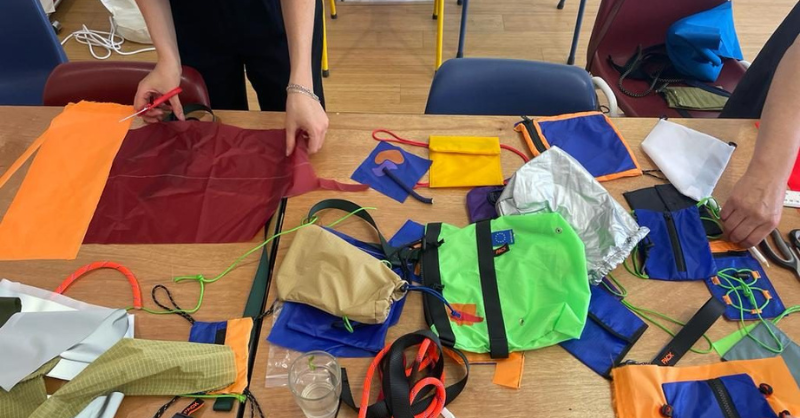
“PackBags”, by Alei Verspoor, will be a series of workshops that are based on an open process with the Higher School of Design of La Rioja. All citizens will be able to participate in them, but it is especially focused on schoolchildren. Bags and textile elements will be generated with recycled materials from actions carried out at the Concéntrico festival in other years. In this way, questions are raised that identify us with the stories contained in the city and Concéntrico, while contributing to a circular economy.
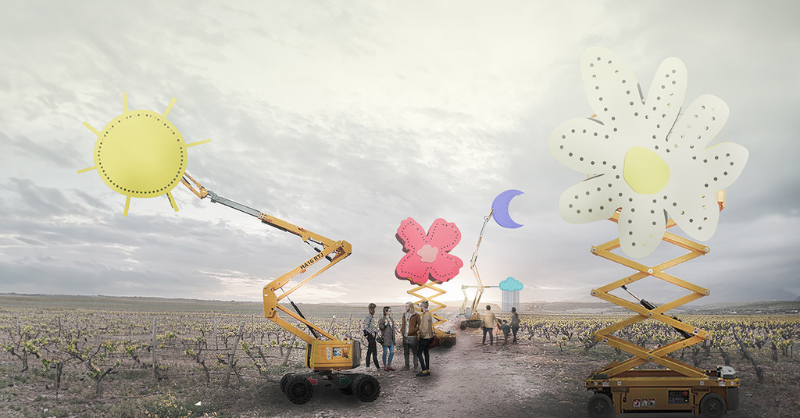
“Cuaderno de surcos”, by ji arquitectos + Blas Antón for Viña Lanciano has been an open process for all primary school children. Through an open call in which 1,142 drawings were received from 18 educational centers, 12 final drawings have been selected, with which interventions will be carried out in vineyards with the intention of improving the link of schoolchildren with the landscape, identity, ecology, sustainability and the plant environment.
Within “The street at 10 years”, the architect Daryan Knoblauch has worked in collaboration with the IES Sagasta to study the surroundings of La Glorieta, Duquesa de la Victoria street and Beti Jai with a temporality of 10 years. In this way, they use conventional urbanism to learn and improve spaces thanks to dialogue with their inhabitants.

The connection between PLANEA and the Concéntrico Festival allows artistic initiatives to be taken beyond the days of the festival and the borders of the region, being welcomed in schools throughout the country where these practices are shown as unique tools for collective learning
Pepa Octavio de Toledo
Head of the Citizen Art axis of the Daniel and Nina Carasso Foundation in Spain
In addition, Concéntrico has opened processes with more than 20 educational centers throughout Spain to carry out two initiatives that are under development, the special projects of Matali Crasset and Maider López will be integrated into these schoolyards during the 2024/2025 academic year. Crasset, the French designer, will carry out “Little Ecologists”, an initiative in which students will be able to explore their environment of nature and fauna through a kit and incorporate it in different stages. With López, the project “How we live the school, how we live the city” will be developed, in which work will be done from the small to the large through collaborative maps and creations with stones, thus connecting the classroom with its environment. The projects are carried out with the collaboration of the art and school network PLANEA and the Government of La Rioja through the Rioja Center for Educational Innovation.
From the Daniel and Nina Carasso Foundation we consider it essential to promote artistic practices of this type, with a social focus, within educational institutions. These proposals not only encourage critical analysis, but also help to forge innovative perspectives, establish renewed links and associate the school with its own community.