Socially engaged art
24 June, 2025
When art enters the school, the possibility of another future is born


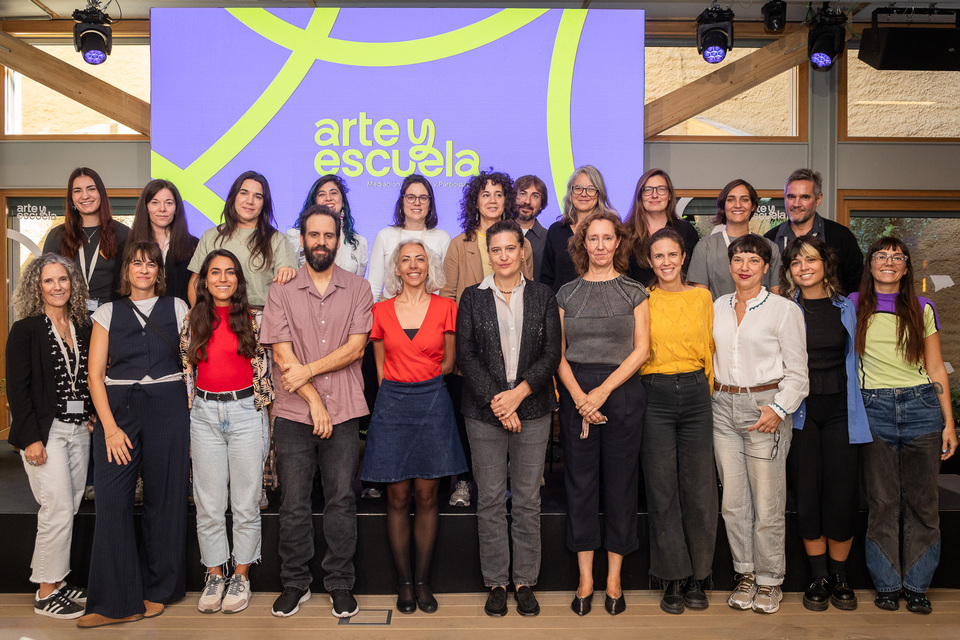
We are building the society of the future and we want it to be sustainable, fair, inspiring and inclusive. To achieve this, at the Daniel and Nina Carasso Foundation we are clear that we must combine art and education, understanding and creativity. From that commitment, we met on June 4 in Madrid, to celebrate the II Conference “Art and School. Building possible futures”, a meeting in which we all share the same purpose: to make visible how the union of art and school can ignite sparks, weave complicities and draw the futures we long for.

With UNESCO’s new Framework for Cultural and Artistic Education and the agenda of the next Mondiacult 2025 Conference as a context, on June 4 we celebrated the II Conference “Art and School. Building possible futures” in Madrid, which we organised together with the Prado Museum. There we brought together decision-makers and those responsible for education, foundations, cultural institutions, teachers and students with the intention of making visible the progress of this intersection, discovering complicities and building together possible futures.

We firmly believe that when art enters the school, the possibility of another future is born. To build it together, we hold meetings such as the Art and School Day
Lucía Casani
General Director of the Daniel and Nina Carasso Foundation
The event was moderated by Mara Peterssen, Program Journalist The Adventure of Knowledge of RTVE, and was inaugurated by Javier Solana, president of the Royal Board of Trustees of the Prado Museum; Ana Moreno, General Coordinator of Education of the Prado Museum; Lucía Casani, director of the Daniel and Nina Carasso Foundation for Spain; Carmen Páez, Undersecretary of Culture; and Abelardo de la Rosa, Secretary of State for Education.

We are aware that the museum also has to be an institution that teaches, so we have many activities so that culture and art are as closely related as possible to education
Javier Solana
President of the Royal Board of Trustees of the Prado Museum
In his speech, De la Rosa stressed the importance of educating in art as a transformative element: “Artistic and cultural competence, expressly recognized in the curricula, is a part of the full development of the personality of students as sensitive, creative and critical citizens“. After the institutional welcome moment, a video was screened in which Ernesto Ottone, Assistant Director-General for Culture of UNESCO, sent a fervent greeting and an important message about the importance of culture in society.

The day began with an interview between Petersen and David Bueno, PhD in Biology and founder of the UB-EDU1st Chair of Neuroeducation. The conversation dealt with the role that artistic practices play in the cognitive, emotional and social development of human beings during childhood and adolescence. “What makes us unique is that we are the only biological species that generated art from the beginning. All the arts question our emotional system. We could not live without emotions,” confirmed the neuroscientist.
In the first table, focused on Cultural and educational models, we address different ways of articulating the intersection between art and education from public policies, as well as their possible adaptation to each local context. The panel was moderated by Paulo Pires de Vale, curator of Portugal’s National Arts Plan – a decade-long strategy in Portugal to achieve a structural dimension of societies based on education and culture: “We have to transform institutions into ‘exhibitions’. They have to open up, get out of themselves, and create more substantial bridges with schools.”
Representatives of cultural initiatives from several countries participated in the conversation. Jazmín Beirak, Director General of Cultural Rights of Spain, He confirmed that “by bringing art and culture to schools we ensure that anyone, regardless of their situation, can develop a cultural life”. For its part, the Director of Culture and Heritage of the French city of Cergy, Christophe Bennet, He explained the project developed in this territory, which aims that “our 8,000 children have, at least once a year, a practice, an artistic encounter”. Catherine Stilmant, director of Parcours d’Éducation Culturelle et Artistique in Belgium, He stated that it is “really important to return today to the development of the democratic spirit in schools. If we don’t have culture and education at the foundation to create these democratic principles, there will be no democracy.” From the other side of the Atlantic, in Panama, the director of the Centro Arte y Cultura de Colón, Abel Aronátegui, explained the way in which the centre he leads works and made special reference to “the importance of introducing administrative records to be able to measure the impact of art education on the most vulnerable groups”.
We continued the day with Cultural institutions and educational communities, a second round table that dealt with how the various internationally recognized cultural institutions are developing specific programs from the Departments of Education and working in a stable way with communities and schools. In addition, we had the opportunity to learn about some projects at a national and international level that are putting into practice the confluence of art and education.
Moderated by journalist Mara Peterssen, the conversation featured three expert voices. First of all Ana Moreno, General Coordinator of Education at the Museo Nacional del Prado, presented the progress made in the DESLIZAR programme, in which the school goes “from being a provider of children to an accomplice and teachers become creators of experiences of cultural participation”. For his part, Ricardo Rubiales, director of the Museum of Light in Mexico, brought his experience in the entity he leads, through which the public traveled through numerous images that reflect the influence of art education in the community to which he belongs. The third speaker, Lilian L’Abbate Kelian, Superintendent of Education at the Tomie Ohtake Institute in São Paulo, Brazil, shared her vision on the role of art education in the construction of democratic communities: “We believe that aesthetic experience and dialogues promote plural communities of belonging and are indispensable for democratic life.”


The third of the tables, Activating Agents of Art and School Practices, dealt with how organized civil society is weaving collaborative alliances from the foundational and educational spheres and with the public administration. The table was moderated by Andrea de Pascual, member of the PLANEA network and coordinator of Invisible Pedagogies, who took advantage of the space to present a publication of the PLANEA Network in which the knowledge of the five years of life of the program has been compiled.
“We are still very atomized,” said Gemma Carbó, from the Alliance of Foundations for Artistic and Cultural Education in Spain, who throughout her speech analyzed the current state of the relationship between art and school. “There are many micro examples, such as the PLANEA network, the Prado network or ConArte, but, nevertheless, we lack the macro, the umbrella, the why, the why.” For his part, Benjamin Gentils, director of La Fabrique de Communs Pédagogiques in France, alluded to the transversality to other areas such as climate. Although their association has 150 years of experimental history, they ask themselves “every morning what it means to educate when the living conditions of the future of that childhood are not guaranteed”. The artistic gaze on this day was present with the participation of Estelle Jullian, architect and project coordinator in Valencia, who presented several of the processes in which she participated or is currently participating: “I work on projects that have a certain bioregional approach where there is a very particular attention to the territory and also on community projects”. Finally, Martí Madaula, artist of A Bao A Qu, explained a residency that he carried out for a full year in a school, time in which “the artist has to make a constant exercise of imagination and also proposes to create a very personal and long-term bond with the students”, alluding to a more leisurely way of working that allows greater depth and impact.
The day concluded by putting into practice some of the issues addressed with the artistic and educational action El silencio sagrado, directed by Christian Fernández Mirón together with students from CEIP San Eugenio and San Isidro (Madrid). This project is part of the PLANEA network and exemplifies the type of proposals that bring art and cultural mediation closer to school environments. Through teacher training and sessions with students, the proposal works with sound, silence, harmony and dissonance as expressive languages, enhancing play, listening and imagination.
Art in school is a right
The conclusions of this UNESCO-endorsed meeting showed that art in schools has scientifically proven benefits; teacher training is essential to achieve long-term goals; administrations and civil society must work in a coordinated manner; programmes need stability and continuity to achieve real impact; and existing structures need to be strengthened with more resources. should be neither a luxury nor an accessory element, but a fundamental right recognized in international commitments
All this in a particularly relevant context – a few months before the Mondiacult 2025 Conference to be held in Barcelona – this conference has contributed to nurturing the international debate on the structural role of art in education and culture as a right. A contribution from practice that highlights the situated, plural and collaborative experience that is being built in the Spanish State.
*Photo credits: Andrea Comas