Philanthropy
05 March, 2024
We discover the finalist projects of the second edition of Tiina at the Demo Day


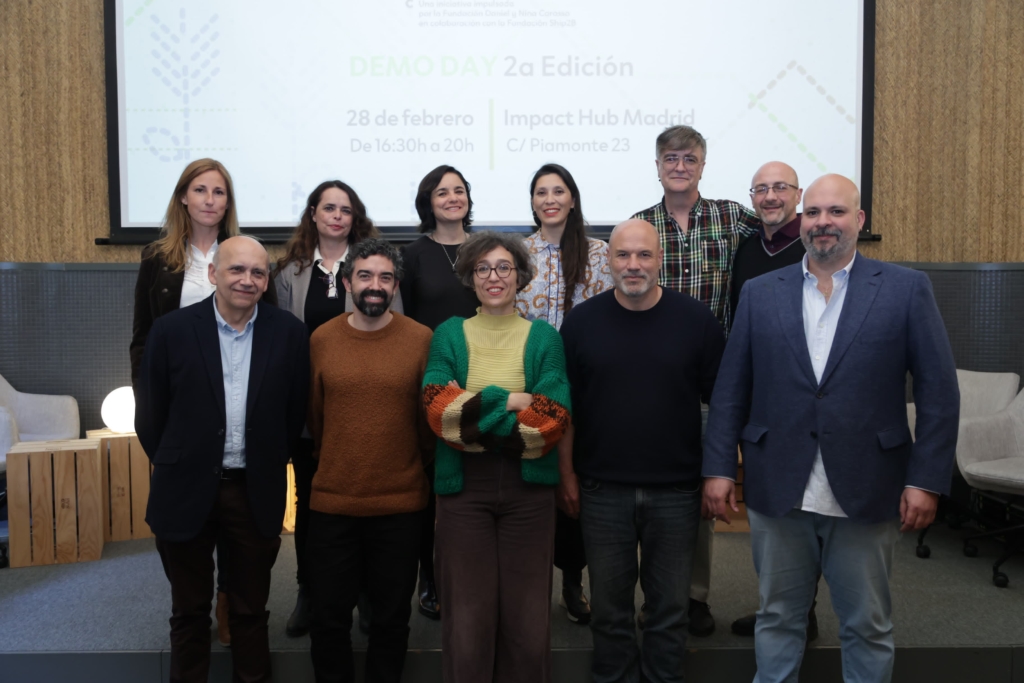
On February 28 we met the seven finalist projects of this year’s Tiina program, in a ceremony in which we also announced the five projects that access the investment fund of 220,000 euros and 30,000 euros in subsidy. This program has the strategic collaboration of the Ship2B Foundation and aims to accompany and finance projects that promote social transformation towards a more ecological, just and inclusive society through sustainable food and citizen art.
The second edition of the Tiina programme concluded with a new Demo Day in which the seven finalist projects presented their growth proposals, objectives and five-year expectations for their performance. During the meeting, the five entities that will access the program’s own impact investment fund were announced: Ecocentral, Fundació Mescladís, Fundació Mas Albornà, Cross Border Project and ConArte Internacional. In addition to them, two other initiatives have also participated in the last phase of accompaniment of the program: Azolla Project and Conciencia Afro.
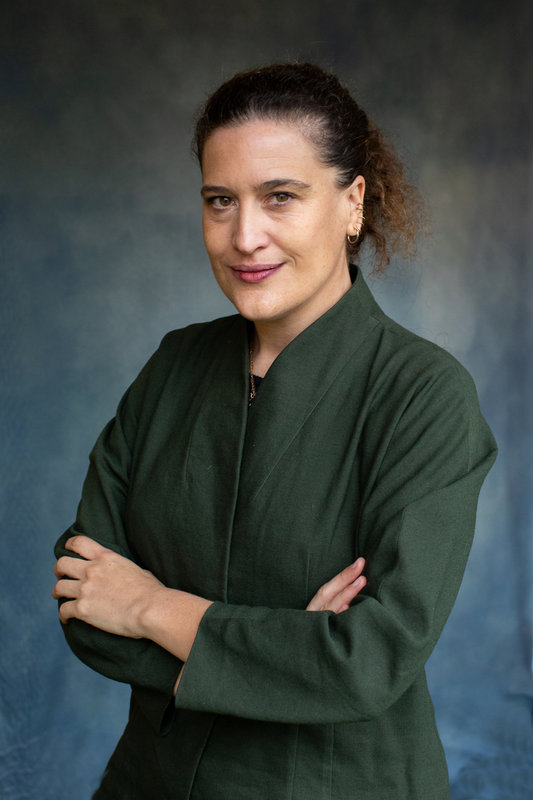
“This investment program was born with the challenge of strengthening economic sustainability and promoting the impact of projects that contribute to social transformation from Citizen Art and Sustainable Food. Also with the desire to generate learning that nourishes the impact investment ecosystem and promotes venture philanthropy in Spain”.
Lucía Casani
General Director for Spain of the Daniel and Nina Carasso Foundation
The results obtained in the first two phases have been very positive and inspiring, demonstrating much greater progress than expected. Therefore, the impact investment of the third phase, in the form of soft loans, is just one part of Tiina, a program carried out by the Daniel and Nina Carasso Foundation and the Ship2B Foundation. “Increasingly, we are working along the lines of Venture Philanthropy through different programs. It’s amazing to see how Tiina’s projects come out. Thanks to very intense work, they achieve a great evolution,” said Guillermo Ricarte, CEO of the Ship2B Foundation.
The Tiina impact investment program is developed in two phases, as explained at the event by Pilar Martínez, head of Sustainable Food programs at the Daniel and Nina Carasso Foundation in Spain, and Anna de Gea, Tiina’s Program Manager at the Ship2B Foundation.
In the second edition, 100 projects were submitted, of which 14 were selected for the first phase, in which a diagnosis was made and their proposals were improved. Of these, seven went on to a second phase of six months, consisting of an intensive acceleration programme in which work was carried out on the impact model and the business model through training workshops. The experience throughout the process is very positive, as reflected in the evaluation survey, according to which 93% of the projects recommend participation in the programme to other entities.

“This second edition shows us that Tiina is a program that invites projects to rethink themselves and develop strategies to boost their impact and economic sustainability, but also to generate community: it allows new connections to be established, to share perspectives, new ideas and energies between projects.”
Pilar Martínez
Head of Sustainable Food programs at the Daniel and Nina Carasso Foundation in Spain
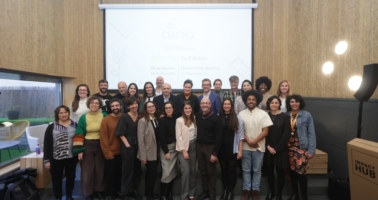
Seven sustainable food and citizen art projects
On the Demo Day, after learning about the main data and learnings from this second edition, the projects selected in the second phase of Tiina were announced, which took the stage to present themselves. Each team delved into the essence of their innovative proposals, revealing their value to transform the future. They shared not only their dreams, but also the financial needs to materialize them.
The Mescladís entity began , which aims to train people at risk of social exclusion and with special difficulty in accessing the labour market (migrants, refugees, women victims of gender violence, etc.) in the hospitality industry. “In this last year with Tiina we have identified that we must consolidate the current restaurant model, improve communication, position ourselves as the catering benchmark and improve penetration in business sectors through training and workshops,” explained Martín Habiague, director of the foundation.
It was the turn of Azolla Projects, presented by Orson Acosta, CEO and founder of the company. This initiative put food sovereignty on the table as a necessary progress to maintain the planet as we know it for longer. To do this, they have three lines of business based on regenerative agriculture, on healing the land itself: Azolla regenerative carbon program (with farmers), Azolla regenerative insetting (with companies) and Azolla regenerative transition (consulting services).
Thirdly, the Mas Albornà Foundation was represented by Joan Clotet, executive director, and Cristina Barbacil, director of communication. This project is the first delicatessen with social impact, which has transformed a traditional workshop into a center for generating employment for vulnerable people in the production of sausages that had the triple objective of reducing the unemployment rate of people with disabilities, improving the generational renewal of businesses and increasing the quality of food.
The last project of the Sustainable Food line was Ecocentral, whose founder, Alejandro Guzmán, explained that they have been working since 2007 as an eco purchasing center for communities, distributing more than 3 million menus last year. The impact is the immediate improvement of the diet of schoolchildren, since agro-industrial products predominate in the centers and Ecocentral seeks to improve them by facilitating the distribution of agroecological products.
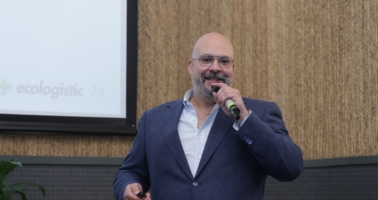
ConArte Internacional, through its Planters project, was the first Citizen Art initiative presented at Demo Day. Marcela Otárola, director of the association, detailed the impact of the work carried out by ConArte Internacional. Not only has it had an influence in these 10 years of journey on more than 10,000 children, but it has also had an impact on teachers, artists and cultural facilities that receive new audiences. “Children want more artistic activities because they feel more part of a community. And a child who feels part of a community is a committed adult,” Otárola concluded.
Yeison García López, director of Espacio Afro, headquarters of the Afro Awareness project, continued with the presentations. This initiative aims to solve the difficulties identified among Afro-descendants living in Madrid, which affect their political, economic, social and cultural rights. To achieve this, he proposed a business model based on services to third parties through training, his own projects such as festivals and a strengthening of the associative fabric through subsidies. “We have to continue irrigating, we consider ourselves a seed project, and for that we need financial support so that the community continues to grow and be recognized by the society to which they belong,” said García.
Finally, Lucía Miranda, director of Cross Border and Ángel Perabá, art-educator in the project, presented this cultural initiative composed of a theater company, an applied theater school and a kitchen to research and develop projects. They did so with the example of the evolution of two people who participated in their first workshops and have ended up dedicating themselves to the performing arts. Its objective is to solve the obvious “disconnection” between performing arts centers and their environments, while the diversity that exists in society is not represented on stage. What is not narrated, does not exist,” Miranda said. The objectives to be achieved are to expand products in mediation and training, incorporate new art-educators, strengthen and retain customers, incorporate a new manager and diversify their income through fundraising.
The five entities that access the investment fund
After the presentation of the seven projects that went to the second phase, Lucía Casani announced the five entities that will receive the funding of 250,000 euros. In Sustainable Food, Ecocentral and Fundació Mescladís received 75,000 euros respectively, and 40,000 euros were awarded to Fundació Mas Albornà.
In Arte Ciudadano, Cross Border Project and ConArte Internacional obtained mixed financing, both receiving loans of 15,000 euros, complemented by a 15,000 euro grant because “the ecosystem of citizen art is very incipient in terms of the generation of projects that combine transformative impact and economic sustainability”, said the general director for Spain of the Daniel and Nina Carasso Foundation. “The grants are intended to finish consolidating the business models of these organizations to boost their self-sustainability and profitability, so that they can support loans without the support of philanthropy.” The final selection sought to balance the number of art and food initiatives, as well as long-term sustainability and their projection into the ecosystem.
A round table with a lot to share
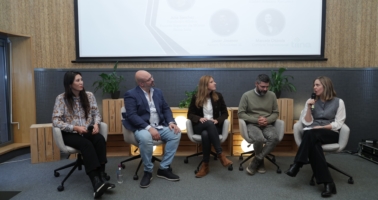
Four projects, selected for their diversity, were part of a round table moderated by Julia Sánchez, director of the Albéniz Foundation. Marcela Otárola (ConArte Internacional), Cristina Barbacil (Fundació Más Albornà), Alejandro Guzmán (Ecocentral) and Javier Jiménez (Aptent) participated in it. They all agreed that the process is hard and intense, but transformative. “We have gone from puberty to maturity in this process, to take the project seriously and think about the future,” said Guzmán (Ecocentral).
“It helped us to focus again on impact, reinforcing our strategy, expanding the team, and having more resources for marketing,” said Javier Jiménez, from the Aptent project, a participant in the first edition of the program, offered a vision of what happens after receiving the loan from Tiina’s impact investment fund. “It’s not just any loan, it’s a loan with pride in belonging to a community with the same goals.”
For his part, Otárola (ConArte Internacional) invited all initiatives that need to define the impact to participate, but taking into account an important requirement: “You just have to be clear that you cannot run alone, but that you need a team.” Likewise, Barbacil (Fundació Mas Alborná) assured that the program is good “for any social entity that is in a project started and wants to scale it, but does not know how to do it: Tiina helps you realize your situation and what is the path you should follow.”
In short, his participation in Tiina is condensed into four concepts: change of mentality, honor, learning, location and impulse.
Towards the third edition of Tiina
In addition, the closing and culmination of the event served to announce the start of the call for the third edition of the Tiina program. Startups, social enterprises and third sector entities can register until April 28, 2024 on the Tiina website, where they can find all the information to send their application. To resolve any questions about these potential participating projects, there will be two online sessions, a webinar on March 14 at 9:30 a.m. and another on April 4 at the same time.
After two fruitful editions and an impact investment of a total of €380,000 through soft loans, eight projects based on Sustainable Food and Citizen Art have improved their ability to respond to social problems and meet their financial commitments. In addition, the program has been extended to the Daniel and Nina Carasso Foundation in France, which has selected and financed five other social impact projects. Thus, our work to promote social transformation grows little by little and edition after edition, generating a great synergy between all the participating entities.
More information about the 3rd edition of Tiina